Guillaume Chanfreau craves close encounters in nature, swimming alongside brilliantly colored reef fish, dolphins, and manta rays outside the confines of a boat–or even scuba equipment. He often feels restrained by his equipment, as the oxygen tank’s bubbles can scare away the wildlife he seeks in the ocean depths.
So, despite being a veteran scuba diver, today he prefers to hold his breath and dive deep into the ocean, a practice known as free diving, which allows for these close encounters with the animals he loves. “It’s actually sometimes easier to get closer to the animal,” he says.
While sitting in his home in southern California, where his day job is as a professor of biochemistry at the University of California in Los Angeles, he reflects on how meeting wildlife in the open ocean–an environment that can never be claimed by humans – has often left him in awe.
“You’re in their territory,” he says, “It’s very humbling…” One memory, in particular, bubbled to the surface: a moment while diving in Costa Rica when he found himself swimming amidst a school of sharks while returning to his dive boat.
“I’ve never been afraid of sharks,” he says. As an experienced scuba diver, he knew the sharks to be harmless, but the moment nonetheless reminded him of humanity’s place in the wild, and one that calls for a deep respect for nature.
“You never know what’s exactly going to happen, or how long it’s going to last,” he says.
This unpredictability of wildlife encounters makes each one unique and thrilling, and one such experience had long lived on his bucket list.
While watching humpback whales spiral through the air off the coast of California (an all-time classic wildlife experience), Guillaume was both in awe and yearning for more: he wished to swim, freely, alongside these gentle giants.
“There are only a few spots in the world where you can actually do that,” he says. That desire is what led him to join an Oceanic Society expedition to Tonga, an ancient island kingdom in the remote South Pacific, home to one of the most storied gatherings of humpback whales in the world.

Humpback whale breaching in Tonga’s open waters.© Roderic Mast
Sharing Water with Gentle Giants
For millennia, Tongans hunted humpbacks to live on subsistence, building deep cultural ties to the visiting whales. But while their harvesting was sustainable, industrial whaling throughout the 19th and 20th centuries pushed whale populations in Tonga, and globally, to the brink of collapse, which triggered a conservation intervention by the Tongan government.
In 1978, Tonga became one of the first countries in the world to ban commercial whaling. Instead of hunting, Tongans turned their deep understanding of humpbacks into a sustainable venture, guiding visitors to witness these magnificent creatures. This shift created one of the world’s most respected whale-watching experiences, showing how ecotourism can transform economies from one that exploits nature to one that appreciates it.
Today, Tonga is one of the few places where travelers can actually swim alongside humpback whales under the guidance of expert local guides who prioritize the safety of the whales and people. Because of Tonga’s strict regulations requiring snorkelers to remain at the surface during whale encounters, Guillaume wasn’t able to put his freediving skills to use, yet he never felt limited by the experience.
“Being on the right boat with the right crew makes a big difference,” Guillaume describes his first outing as his Oceanic Society expedition embarked from the idyllic sandy shores of ‘Utangake, an island within the Vava’u region in the northeastern corner of Tonga, in search of humpbacks.
Their captain scanned the choppy South Pacific horizon, looking for the breach of a fluke or a puff of water vapor. Then excitement swept across the boat as the captain spotted a pair of whales in the distance.

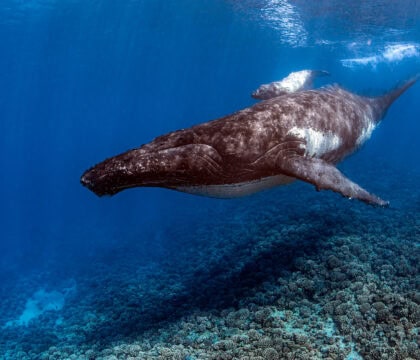
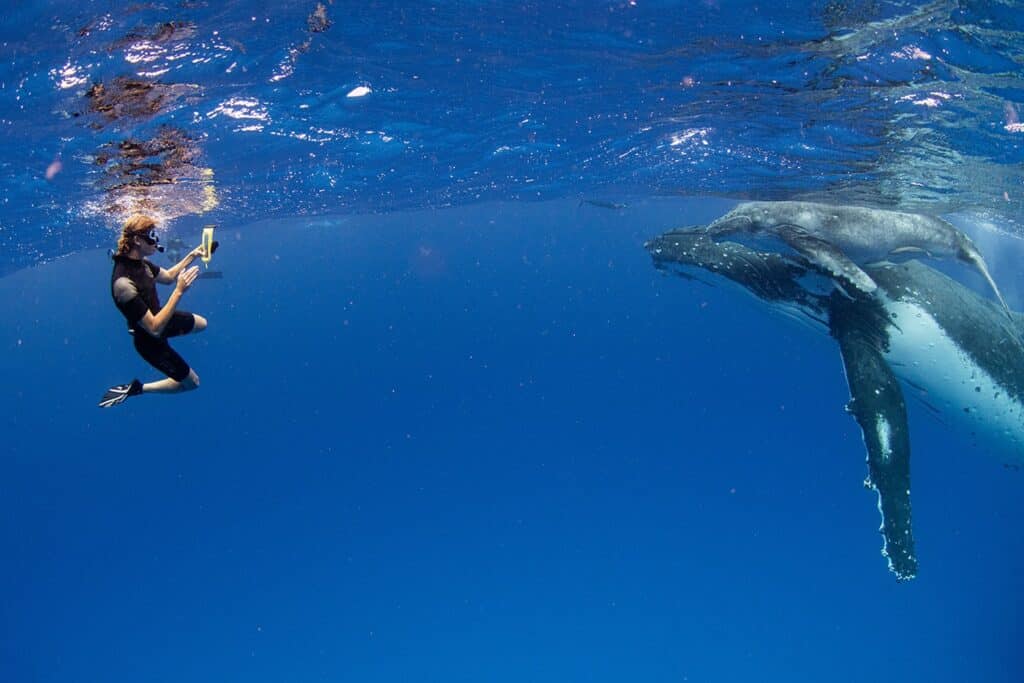
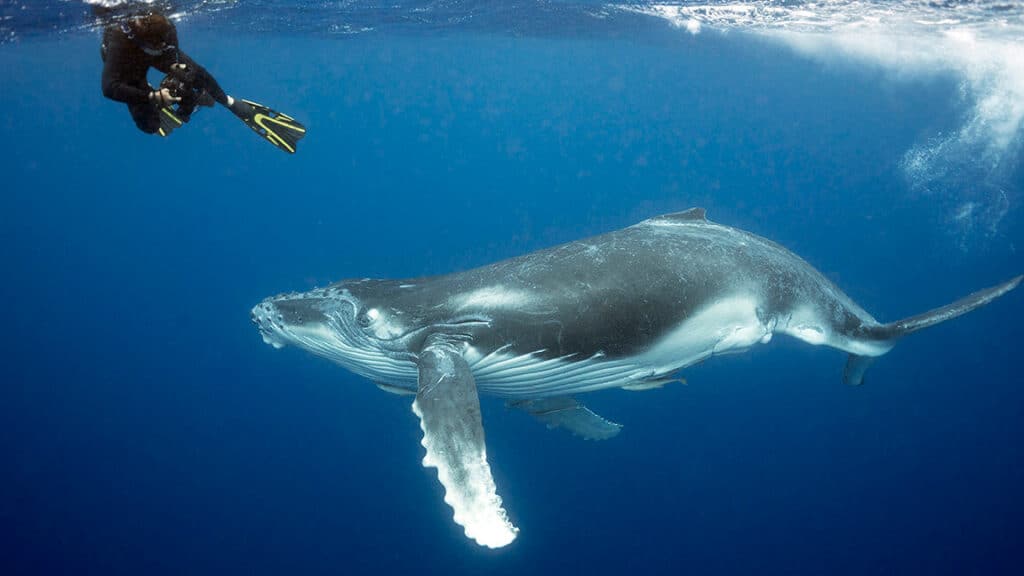
Mother and calf humpback whales swim gracefully in Tonga’s waters. ©Guillaume Chanfreau
Their vessel carefully approached the whales. As they neared, Guillaume prepared to follow their guides into the open ocean and positioned themselves above a mother and calf who were gently sleeping in the depths. The sunlight reflecting off their skin can make resting humpbacks look like glowing white lanterns in the dark ocean.
“You don’t want to wake them up,” he says, so their guide instructed them to swim quietly and rest at the surface, and wait. Then, the whales drifted up to the surface to breathe, quickly transforming from a ball of light in the deep to creatures the size of firetrucks. Even while moving sleepily, their size and power regularly stun travelers.
“It’s kind of a dream come true…” he reflects on the first encounter, where the whales passed by the group of awestruck tourists floating at the surface, sometimes within a few feet. “Finally, you get to see them. And the size is just–it’s massive–and so it makes you really humble.”

Traveler Guillaume snorkeling through a stunning Tonga cave, surrounded by a swirling school of sardines—an underwater spectacle like no other! ©Guillaume Chanfreau
One of Guillaume’s favorite experiences in Tonga was not with a giant whale, but with tiny sardines. In addition to seeking out humpbacks, his expedition also explored Tonga’s underrated coral reefs. While exploring these reefs and the coastal caves that dot the shoreline, Guillaume came across a massive school of sardines, and he was compelled to swim through its center. The sardines swirled around him in a swarm so thick they blotted out the sun–and the moment earned its place amongst Guillaume’s favorite snorkeling experiences.

But any trip to Tonga inevitably focuses on swimming with humpbacks, an experience offered in only a few places in the world. Over the course of the week, their group spotted humpbacks every day of their journey, watching them fly through the air with their famous acrobatics, and even observed a pack of males surge through the Pacific competing for a mate, which requires expert timing and guidance to view safely.
“It helps to have a guide with good intuition,” says Guillaume, who was amazed by the team of local guides’ knowledge of humpbacks and the seascape.
While viewing sleeping mothers and their calves is a “relaxing” experience according to Guillaume, viewing active whales is a “high voltage” experience that requires travelers to swim quickly across the open Pacific to the ideal position, known as the “whale sprint,” which can be physically demanding.
“It’s like: ‘swim for your life’!” laughs Guillaume, but he highlights that it was worth the effort to watch these creatures move powerfully through the ocean. “We got incredibly lucky,” he says, “The water was super clear.”
But it was the humpback calves that were most memorable for Guillaume. Calves are typically the most playful and curious of human bystanders, and will often swim up to travelers, locking eyes, or even nudging them gently with a fin as they come up for a breath.
On the last day of their trip, a calf approached Guillaume under the watchful gaze of the mother, and though Guillaume knows that humans tend to anthropomorphize animal behaviors, he felt as if the young whale was saying goodbye.

“That was just, you know, a perfect way to end a trip,” says Guillaume of the experience. Despite being perhaps just a foot away from a baby humpback (which is still the size of an SUV), the encounter didn’t frighten Guillaume.
Embracing the Uncertainty of Wildlife Encounters
Today, as Guillaume reflects on his travel to Tonga, he recognizes that he had a special journey and one that can never be promised.
As an experienced ecotourist, he understood that viewing wildlife is never guaranteed. “You’re looking for them, but you never know if you’re gonna find them,” he says.
Even in the company of expert naturalists who understand the animals and the environment intimately, like the Tongan guides, wildlife is entirely unpredictable. All any tour operator can do is plan to be in the right place at the right time, and hope for the best.
But veteran wildlife adventurers also understand that it is precisely the uncertainty of wildlife encounters that makes them so special–offering a true window into the natural world, one that does not adhere to human demands. As a result, sightings leave travelers feeling privileged, something that cannot be compared to a zoo or using a lure to attract wildlife. And for many, those moments are priceless.
When those moments do come, like when a baby humpback whale swims up to you to say goodbye, Guillaume stresses the importance of living in the moment. In fact, despite being a talented and passionate photographer who appreciates capturing memories, he holds only one regret:
“It might have been better with no camera,” he muses, “Because you’re experiencing the moment better.”