The open waters off California’s Farallon Islands are alive with marine life, from seabirds resting on the swells to apex predators patrolling the deep. On November 11, Oceanic Society naturalists and passengers on our whale watching expedition were treated to a rare sighting of a solitary mature Bigg’s (transient) killer whale, far from its usual group. This remarkable observation offered a unique window into the dynamic and often unpredictable nature of the California Current ecosystem.
The day began with a striking sight near the islands, where a great white shark cruised near the surface, giving passengers an awe-inspiring view of this iconic predator.
As the group moved offshore toward the continental shelf to expand the search for marine mammals, a Tufted Puffin came into view. Winter sightings of this species are uncommon in the region, making for a remarkable opportunity to photograph the bird.
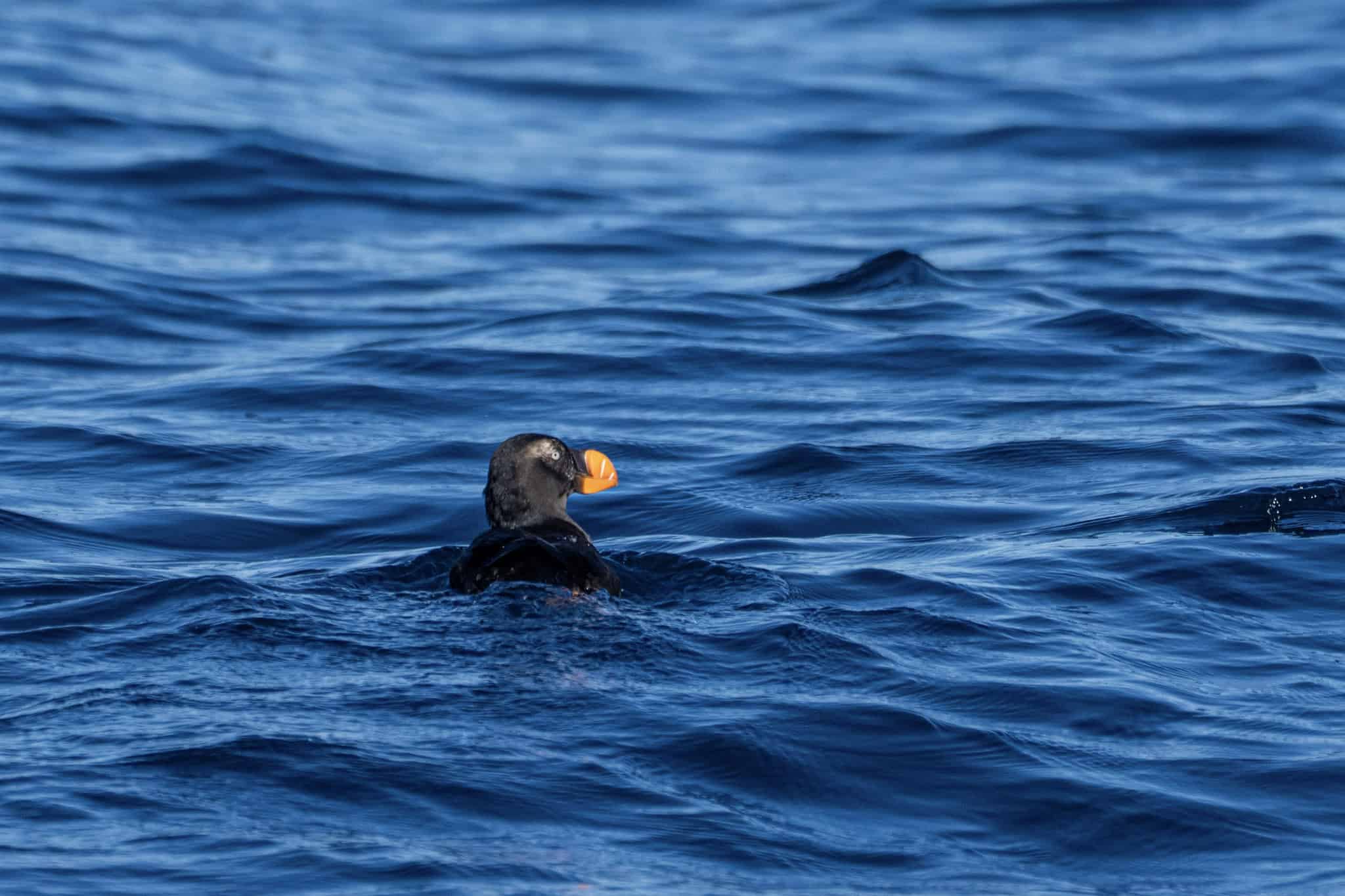
Winter wonder: A tufted puffin (Fratercula cirrhata) graces the chilly December waters off California’s Farallon Islands, where these “sea parrots” are more typically spied in their vibrant breeding plumage during summer months. Spotting one now is a true rarity, as they disperse offshore post-breeding to forage on fish and squid in the vast Pacific. © Chris Biertuempfel
A Rare Solo Male Killer Whale Spotted
In the distance, something even more extraordinary surfaced: a tall fin cutting through the swells nearby. It was immediately clear, based on the size and distinctive shape of the dorsal fin, that an adult male killer whale was moving through the area.
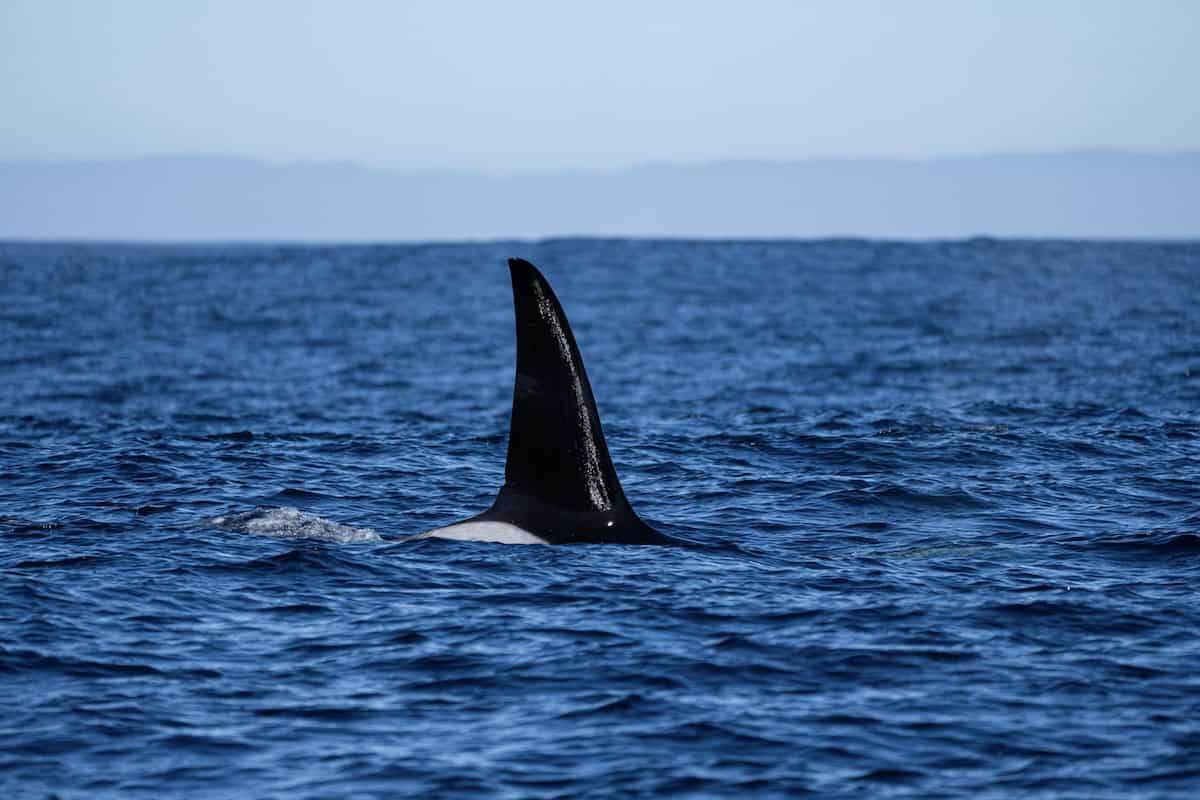
Sighting the iconic dorsal fin of CA212A—a towering male from the elusive CA212 pod of Bigg’s (transient) killer whales—gliding through the Pacific off California’s Farallon Islands. © Chris Biertuempfel
“High-quality photographs and quick coordination with research teams in Monterey Bay and southern California allowed us to confirm the individual as CA212A, a well-known male from the CA212 family group of Bigg’s Killer Whales”, recalls on-board naturalist and photographer, Michael Pierson.
Identifying the animal relied on the same careful photo ID techniques used in long-term research. The unique shape and height of his dorsal fin, the distinct contours and markings of his saddle patch, and the size and placement of his eye patch were all used to confirm his identity. CA212A carries a set of notches and marks on his flukes that make recognition straightforward, thus allowing us to confidently document his unusual behavior.
Bigg’s Killer Whales in the Farallones
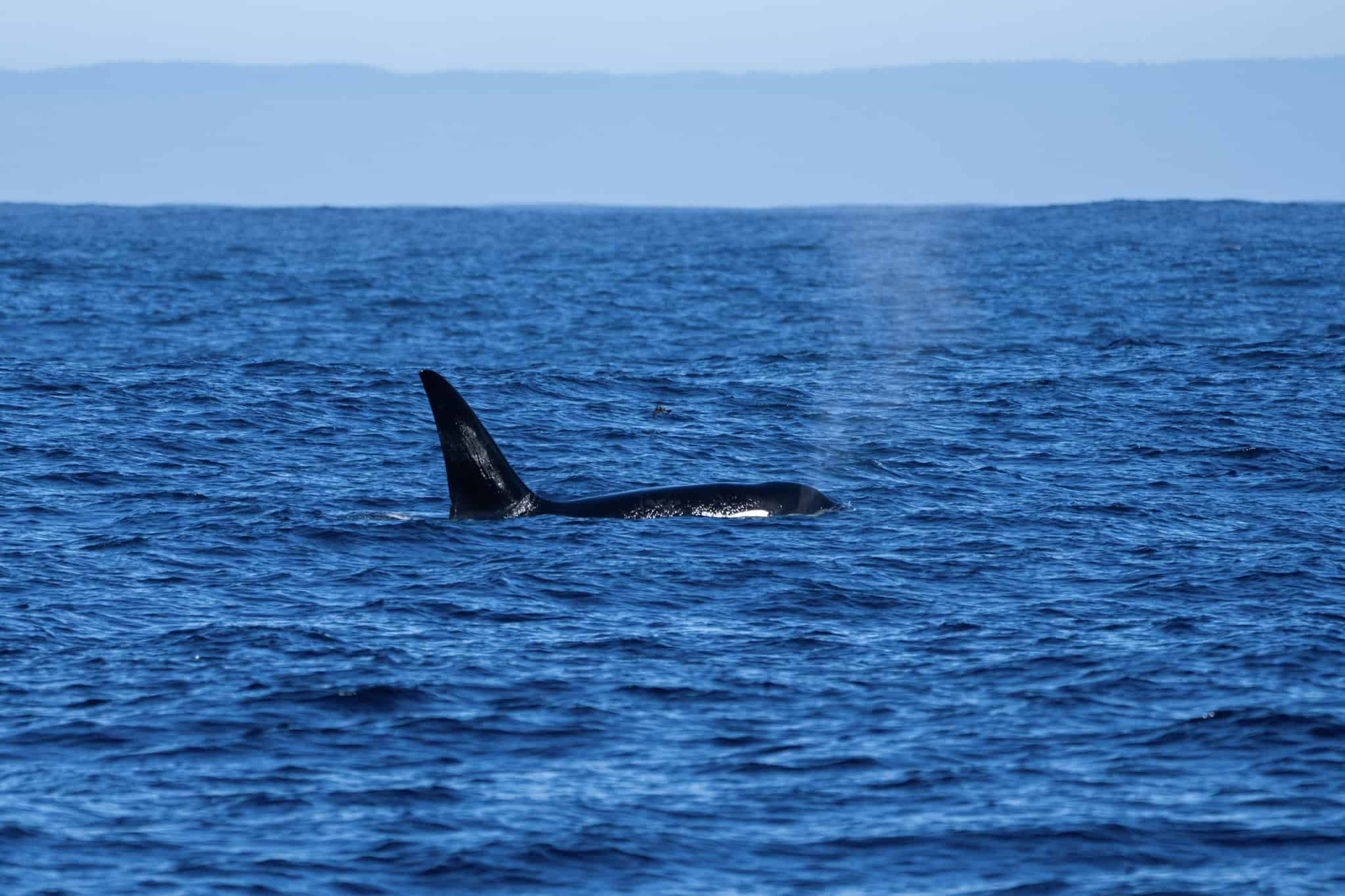
Captivating moment as CA212A, the powerful Bigg’s killer whale breaches the surface, exhaling a misty plume while its iconic dorsal fin and saddle patch gleam under the sun. © Chris Biertuempfel
Bigg’s killer whales, sometimes called transient killer whales, are a distinct ecotype of orca known for hunting marine mammals rather than fish. They are highly intelligent and stealthy predators, traveling in small, tight-knit family groups and relying on strong social bonds to share knowledge about hunting and survival.
Though this sighting was uncommon, our team has encountered orcas near the Farallon Islands on several occasions. These striking animals are among the more distinctive marine mammals regularly seen in these waters. Multiple ecotypes have been recorded here, but transient (Bigg’s) killer whales are the ones most often spotted.
Understanding Orca Matrilines and Social Structure
What made this sighting particularly remarkable is that CA212A has historically been documented only in the company of his matriline, the social unit centered on a female ancestor, usually the mother. Matrilines are the backbone of killer whale society, with offspring, siblings, and successive generations traveling together and maintaining close bonds that influence hunting strategies, social learning, and movement patterns.
For a male from a stable matriline to appear alone is extremely rare. In fact, according to regional cataloging specialists, this was the first verified sighting of CA212A traveling solo.
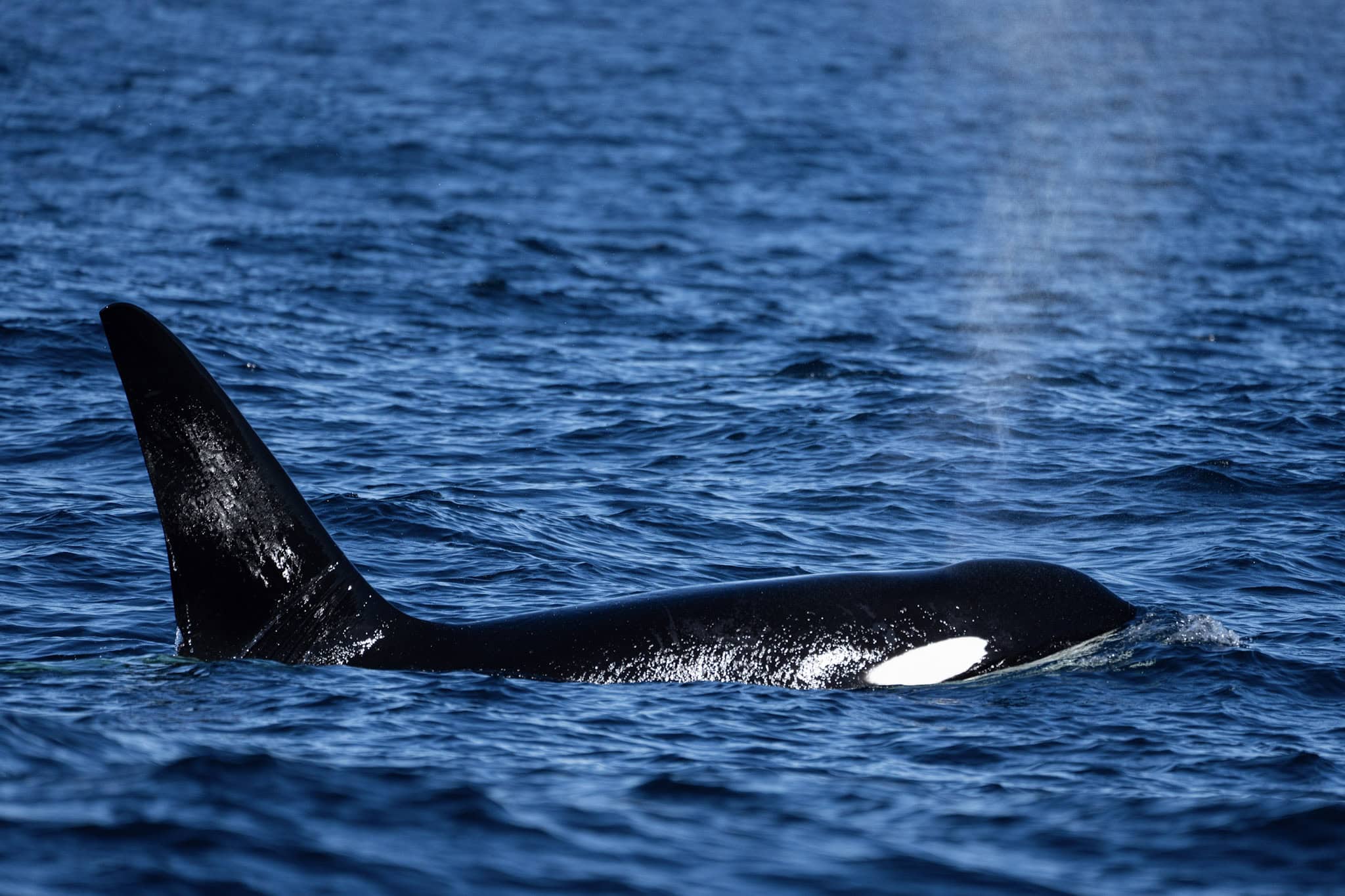
Close-up of male Bigg’s killer whale CA212A showing the unique shape of his dorsal fin, saddle patch contours, and fluke notches that allow for individual identification, documented during a rare solo sighting away from his matriline. © Chris Biertuempfel
Insights into Movement and Behavior
“For roughly ten minutes, he maintained a steady travel path that allowed us to observe him closely before he initiated a long dive and disappeared from view,” recalls Pierson, whose photographs helped confirm his identity.
For those on board, it was a breathtaking experience watching this being move with power and precision, its sheer size and presence commanding the water up close.
Those ten minutes offered a rare glimpse into the life of a solitary adult male Bigg’s killer whale, a behavior almost never documented in this region.
Though the encounter was brief, it provided valuable insight into the movement patterns and behavioral flexibility of this seldom-seen family of killer whales. The CA212s were last reported near the Channel Islands, far to the south, making this solitary appearance a fascinating clue about seasonal ranges and individual exploration.
For our expedition guests, witnessing a male killer whale traveling alone was an extraordinary and humbling reminder of the dynamic nature of the ocean and the intricate social structures of its inhabitants. Moments like these, unexpected, fleeting, and deeply educational, are why the Farallon Islands and the surrounding California Current remain such compelling destinations for marine research and wildlife observation. Each sighting adds a piece to the puzzle, revealing the lives of these remarkable predators and the subtle rhythms of the ecosystems they call home.