In the crystalline waters of Fiji’s Beqa Lagoon, where strong currents sweep over vibrant reefs, Oceanic Society Naturalist and Associate Director of our Behavior Change program, Lindsay Mosher, knelt shoulder-to-shoulder with fellow divers behind a chest-high barricade 60 feet below the surface. She had just finished leading an expedition to Snorkel Fiji’s Rainbow Reef and Beqa Lagoon seascapes, but something kept tugging at her: the chance to witness Fiji’s sharks up close. “It seemed like a once-in-a-lifetime opportunity, and I didn’t want to miss out on it,” she recalls.
This wasn’t Lindsay’s first in-water experience with sharks. She’s swum alongside silkies and reef species in Cuba, some impressively large, but paling against the tigers and bulls here in Fiji.
Drawn by the incredible reputation of Beqa Lagoon Resort’s long-running shark dives, she extended her stay to join a provisioned encounter at a site known as The Cathedral.
Inside Fiji’s Most Iconic Shark Dive
Divers descended single-file along safety ropes, past a shallow reef into a rubble-strewn seafloor, where the barricade provided a secure viewing perch.
Directly on the other side of the platform, about 10–15 feet away, sits a large metal feeding box containing tuna heads. The setup is carefully managed for safety with two feeders and three or more guides in front to monitor shark behavior, while two additional guides behind the platform use redirection poles when needed. The operation ensures a controlled environment that is safe for humans and designed to avoid harming the animals.
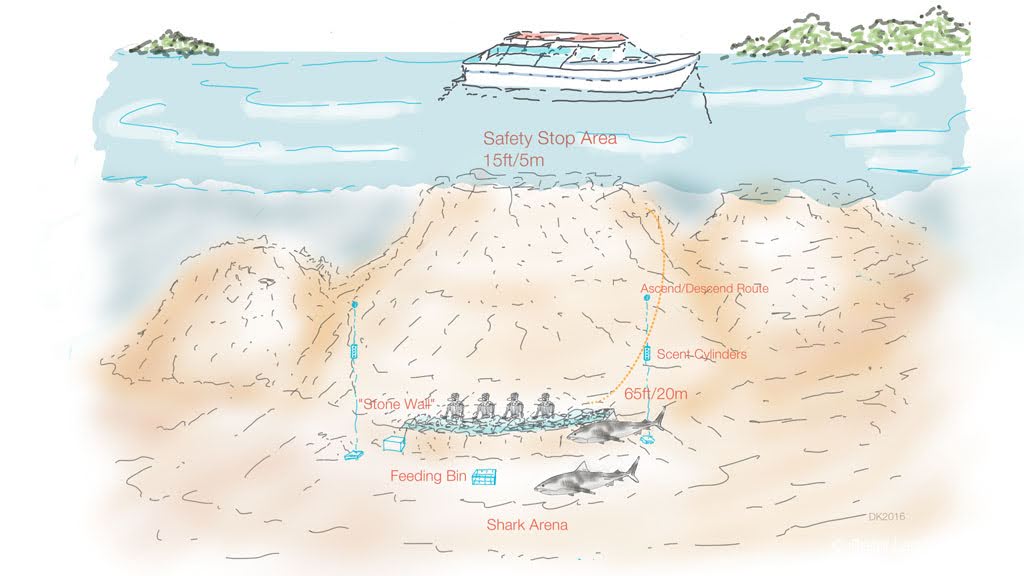
Layout of The Cathedral dive site: see where divers descend and ascend, the shark feeding area behind the safety wall, and key depths and reef features.
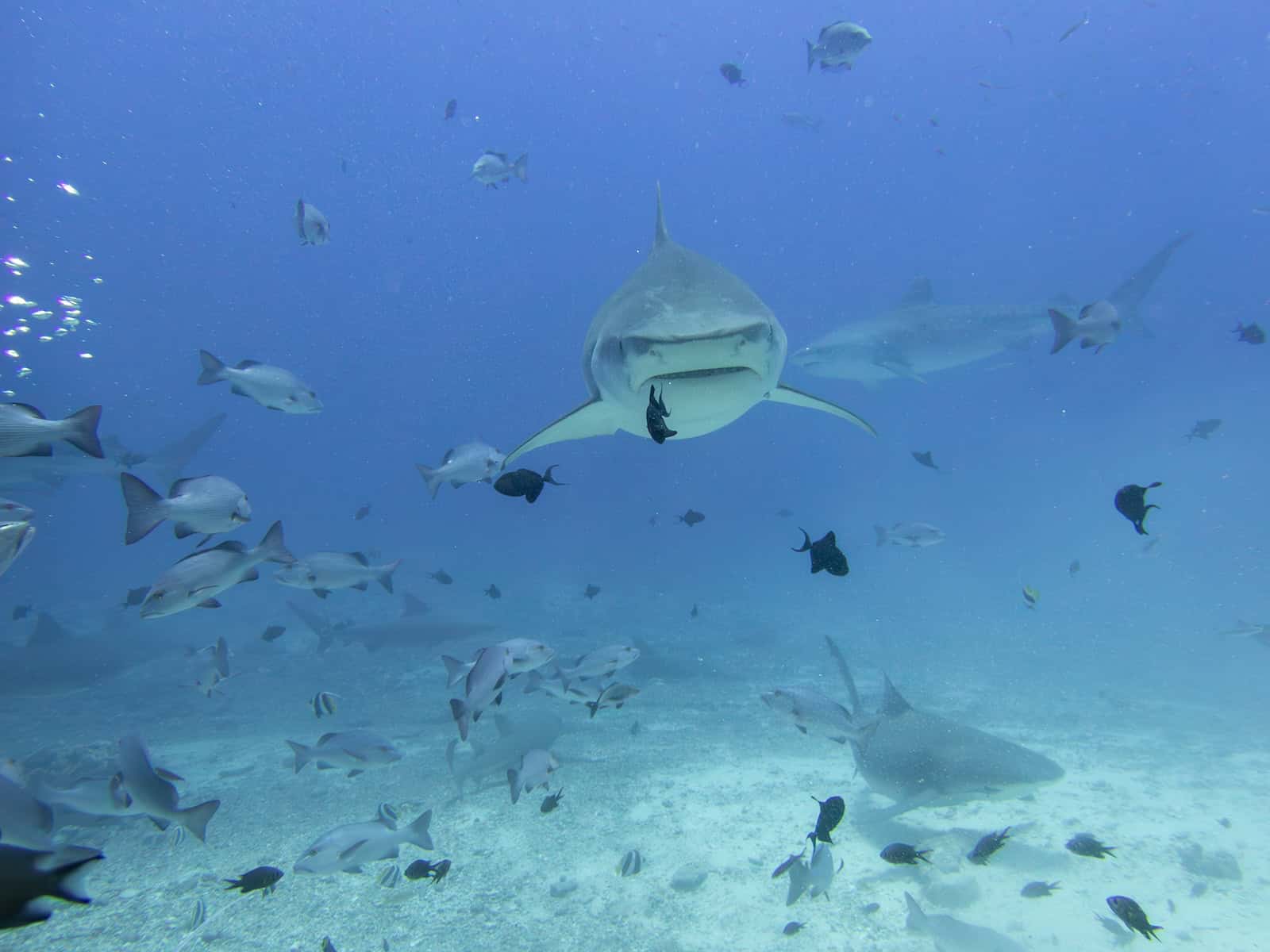
Depths hovered around 60 feet with visibility stretching over 80 feet, creating an ideal stage for observations. The two 25-minute dives offered an unparalleled window into the ocean’s apex predators: tiger sharks with their striking striped patterns, massive bull sharks exuding sheer girth, a pair of lemons, and graceful nurse and blacktip reef sharks.
In this moment, Lindsay found herself not gripped by fear, but by profound amazement. “I expected to feel at least a little nervous initially,” she reflects, “but I really didn’t. I just felt amazed.”
What surprised Lindsay most was the way different species interacted. Instead of the territorial clashes she expected, the sharks moved through the site in an almost “organized and orderly” rhythm. The most breathtaking moments came when they glided directly overhead with fins passing so close she instinctively ducked. “Absolutely amazing,” she says.
The true emotional pinnacle came in those unguarded instants when a shark passed close enough for her to meet its gaze. She describes the moment as “absolutely unforgettable,” recalling how being eye-to-eye revealed details she’d never seen up close: the intricate striping of the tiger sharks, the sheer girth and presence of the bull sharks. Seeing them at such proximity, she says, “was spectacular”.

Balancing Thrill with Stewardship
Alongside the wildlife spectacle, conversations with the lead operator, Brandon Paige, illuminated how such tourism bolsters local economies and conservation. “Beyond the experience of viewing the wildlife, it was excellent to speak with Beqa Lagoon’s Dive operator to hear about how this specific tourism supports the area and their wider conservation efforts.”
These dives, offered two to three times per week, are provisioned, meaning the sharks are familiar with the site and often arrive expecting meals. But as the operator candidly explains in a shared video perspective, this isn’t unchecked indulgence.“Feeding wild animals is a very controversial topic,” he explains in the video. “Sharks are likely patrolling Beqa Lagoon every day in search of scraps of dead or degraded fish, but placing food here does attract more sharks. That said, they are not hand-fed, overfed, or fed every day, so any changes in their behavior are minimal.”
At its core, this experience transcends adrenaline; it’s a deliberate bridge to empathy. “Experience promotes understanding,” the Beqa Lagoon dive operator emphasizes, “and every diver that visits this site takes home an experience that renders them a shark ambassador—an urgently needed protector of these wonderful animals. So from that perspective alone, we believe it’s a good thing.”
The guides were forthright about the trade-offs. While provisioning isn’t natural hunting, it sustains populations amid surrounding reefs ravaged by overfishing. Tourism experiences such as this help to fund marine protected areas like The Cathedral site itself, with spillover benefits for local economies. The lead operator even hosts community presentations to dispel shark misconceptions, fostering pride in ocean wildlife.
Lindsay echoes this candor, appreciating the operator’s transparency on behavioral alterations. Yet she underscores the greater good: These dives offer “an unparalleled up-close experience that can shift perspectives and generate crucial conservation support.”

Challenging Fears and Embracing Respect
Travelers often imagine sharks as menacing predators, thanks to pop culture portrayals. But Lindsay’s encounters reveal the truth. “Many travelers are frightened by the idea of seeing sharks… but once you actually encounter them at eye level, you realize that fear is misplaced or at least skewed.” In reality, many species are timid, fleeing at the sight of divers, or merely curious before resuming their graceful patrols. “Seeing them in the wild, in their natural habitat, and witnessing how graceful and elegant they are underwater is one of the most wonderful experiences you can have because it’s the ocean as it should be.”
Seeing sharks up close, she adds, builds “a healthy respect and better understanding.” Their mere presence indicates ecosystem vitality: By preying on mid-level herbivores and weaker individuals, sharks prevent overgrazing and promote biodiversity, as detailed by NOAA’s National Marine Sanctuaries. In fishing-stressed regions like parts of Fiji, such indicators become vital signs worth protecting.
A Call to Deeper Waters
Lindsay’s journey in Beqa Lagoon reminds us that awe can be a catalyst for action. As shark populations face global threats from overfishing and habitat loss, experiences like hers turn observers into advocates. “The presence of sharks means a healthy reef,” she says. “It’s a gift to witness them in the wild.”
At Oceanic Society, we champion responsible encounters that prioritize animal welfare and long-term stewardship. Whether through guided expeditions or community education, we invite you to dive deeper, metaphorically or literally, into the ocean’s wonders. What if your next adventure not only inspired you, but amplified protections for these essential guardians? The sharks are waiting, elegant and unassuming, for us to rise as their ambassadors.