We’re excited to announce that six newly tagged leatherbacks are now live on our satellite-tracking platform. Some turtles have already been named, while others are still awaiting theirs.
At any given moment, a leatherback sea turtle may be crossing a shipping lane, diving 1,000 meters into the dark to hunt jellyfish, or navigating by the Earth’s magnetic field toward a feeding ground thousands of miles from where it was born. And thanks to six satellite tags deployed this nesting season on the beaches of Trinidad, you can follow along on the journeys of a few of these remarkable creatures.
Our Satellite Tracking Program gives you a front-row seat to one of nature’s most remarkable journeys. Each turtle on our live map is a real individual with years of history, including nesting records, biometric measurements, and tag data collected by field researchers who have been monitoring these animals for decades.
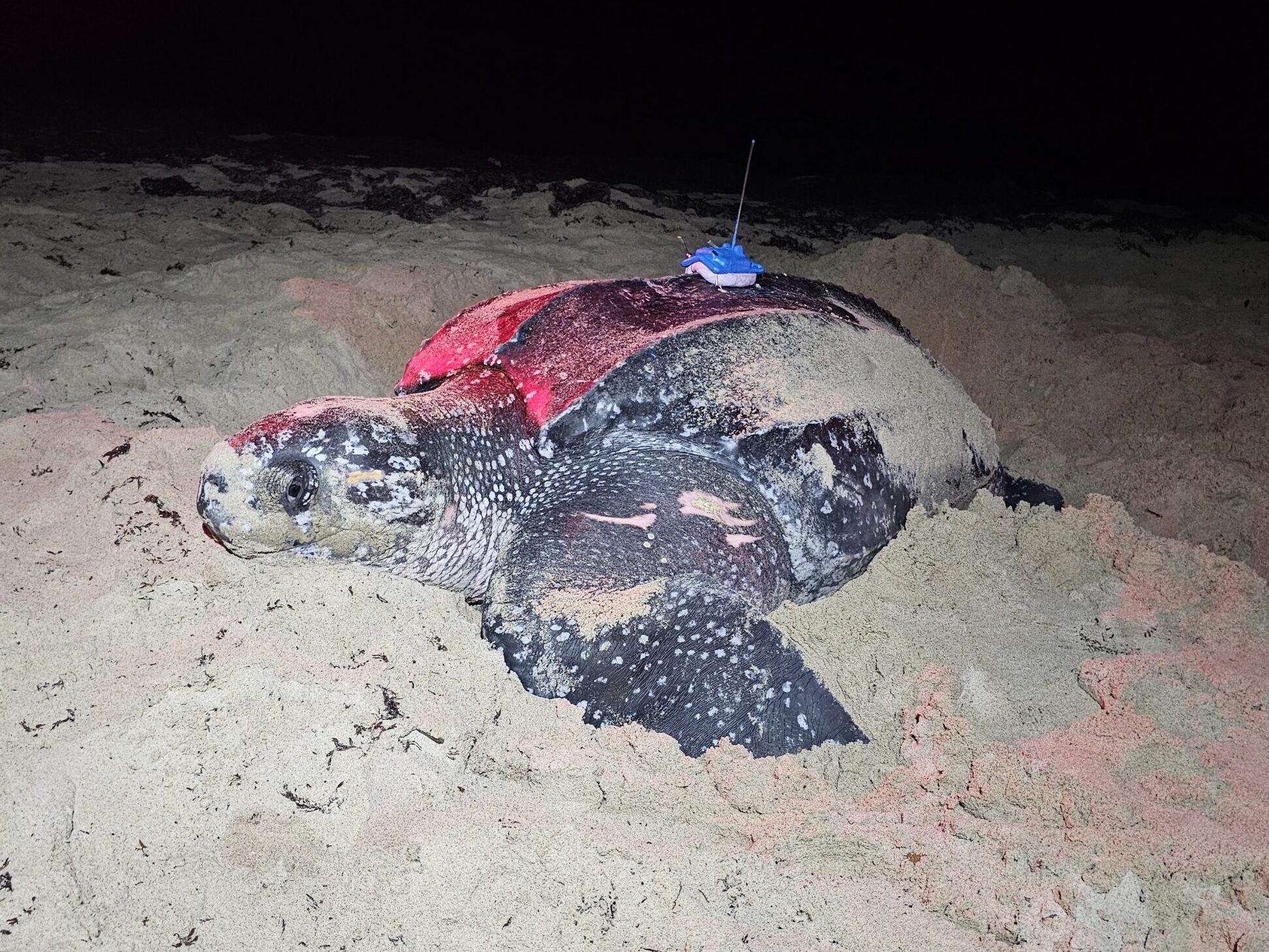
Leatherback 982000361979733, carrying satellite tag 45650, was tagged on April 7, 2026. Measuring 156 cm (5 ft 1 in) long and 117 cm (3 ft 10 in) wide, this powerful adult female is now helping researchers better understand leatherback migration as she travels between nesting beaches and the open ocean.
Name a Turtle, Watch Her Journey, and Support Conservation
Naming a sea turtle is more than a symbolic gesture — it is a direct contribution to the conservation work that makes their survival possible. Your support helps fund the field researchers, satellite technology, and long-term monitoring needed to better understand and protect these remarkable animals.
When you name a leatherback sea turtle, you’ll receive a personalized certificate featuring her full profile, along with a leatherback fact sheet. Her given name will also appear on her public tracking profile as she travels across the open ocean.
Each turtle’s location updates daily as she completes her nesting season in Trinidad, where she was tagged, before beginning her remarkable migration north to Nova Scotia. There, she will forage for jellyfish and replenish her strength after the demands of nesting and her long ocean journey.
Name a Satellite-Tracked Leatherback Turtle
Leave a lasting mark on ocean conservation. For a tax-deductible donation of $2,000, name a satellite-tracked leatherback turtle and follow her migration across the open ocean.
Conservation Behind Every Tag
Nature Seekers
The newly deployed satellite tags are made possible through our partnership with Nature Seekers, a community-based conservation organization in Matura, Trinidad, that has become one of the world’s most respected leatherback research programs.
Nature Seekers was founded in the 1990s by local community members concerned by the high mortality of nesting leatherbacks along their coastline. What began as a small effort to shift perceptions through guided nighttime turtle tours has grown into an extraordinary conservation success story.
Today, Nature Seekers has helped all but end the slaughter of nesting turtles in the area while inspiring both local communities and the broader nation to value and protect sea turtles. The organization conducts long-term monitoring of nesting females, maintains research records spanning decades, and deploys satellite tags each season to follow where these turtles travel after leaving the beach. Their commitment to community-led stewardship offers a powerful model for conservation built from the inside out.
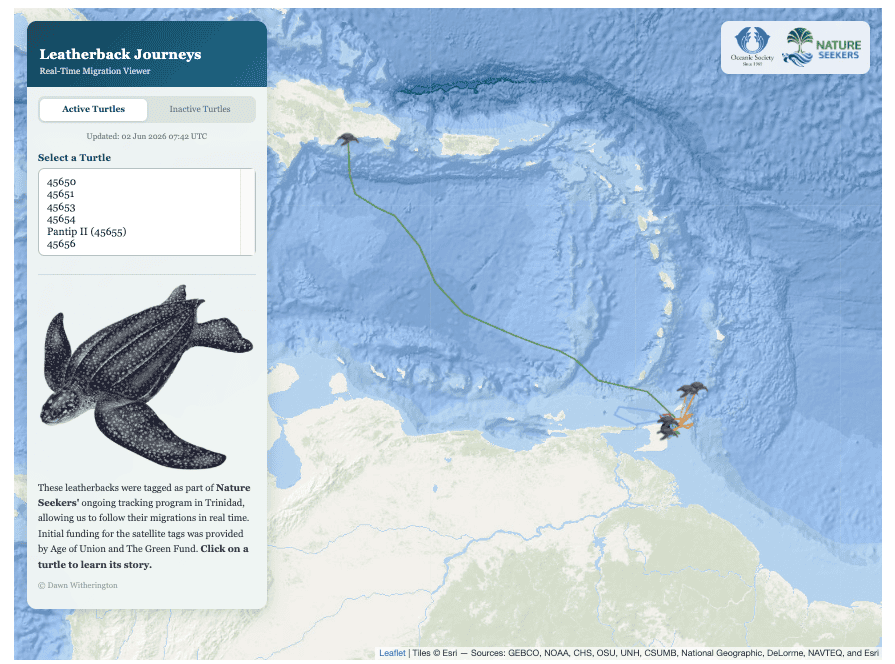
This map traces the real-time movements of a satellite-tagged leatherback turtle as she journeys between her nesting beach and the open ocean, offering a rare glimpse into one of nature’s most remarkable migrations.
SWOT
This program also supports Oceanic Society’s sea turtle conservation program, State of the World’s Sea Turtles (SWOT), a global initiative that synthesizes and shares sea turtle science to advance conservation worldwide.
SWOT serves as a bridge between field researchers and the broader public, translating complex science into accessible and meaningful stories. The satellite tracking platform extends that mission by bringing the reality of leatherback migration beyond scientific literature and into the hands of anyone curious enough to follow the journey.
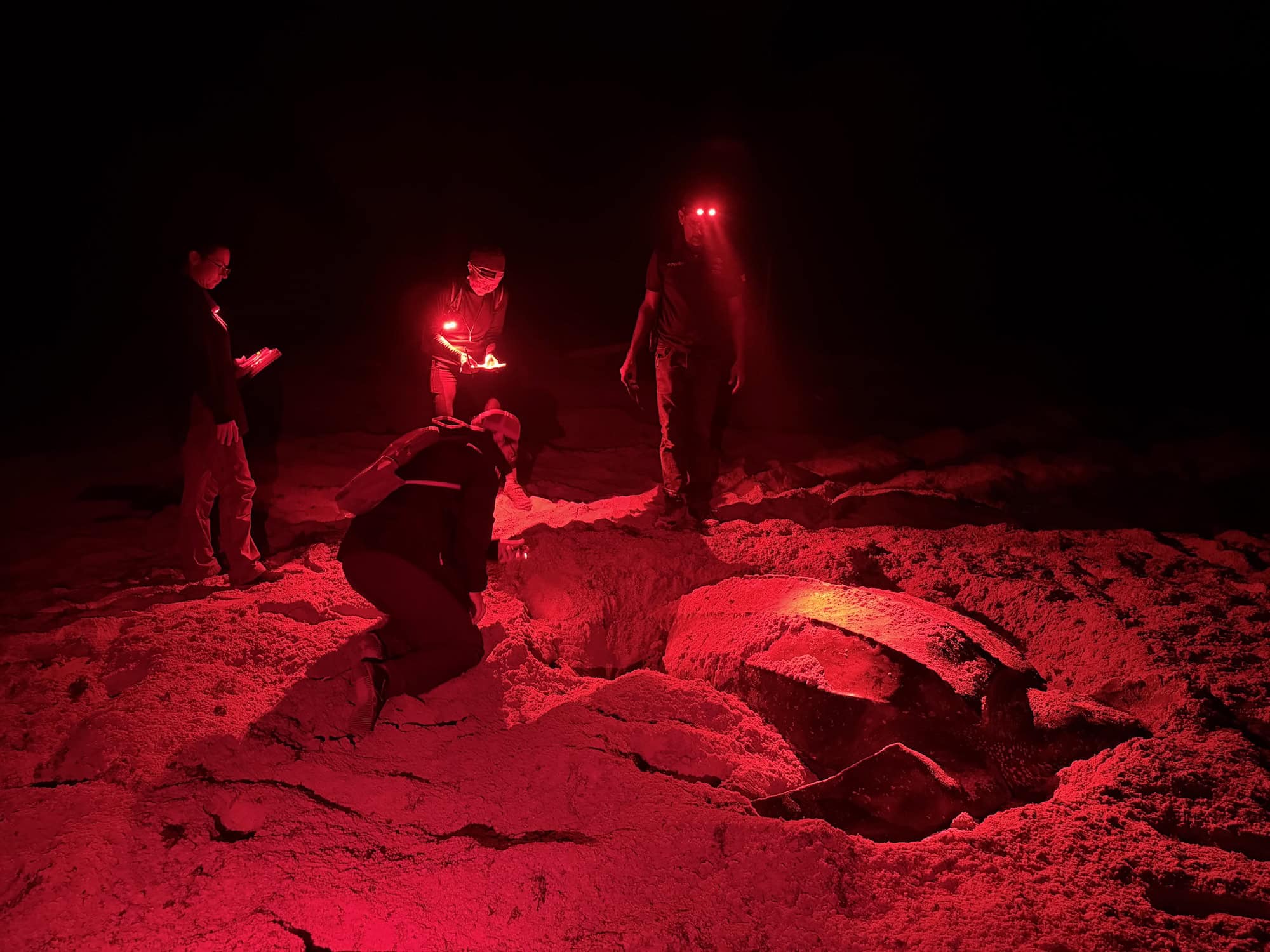
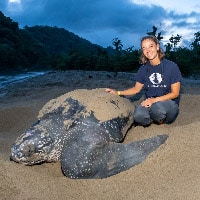
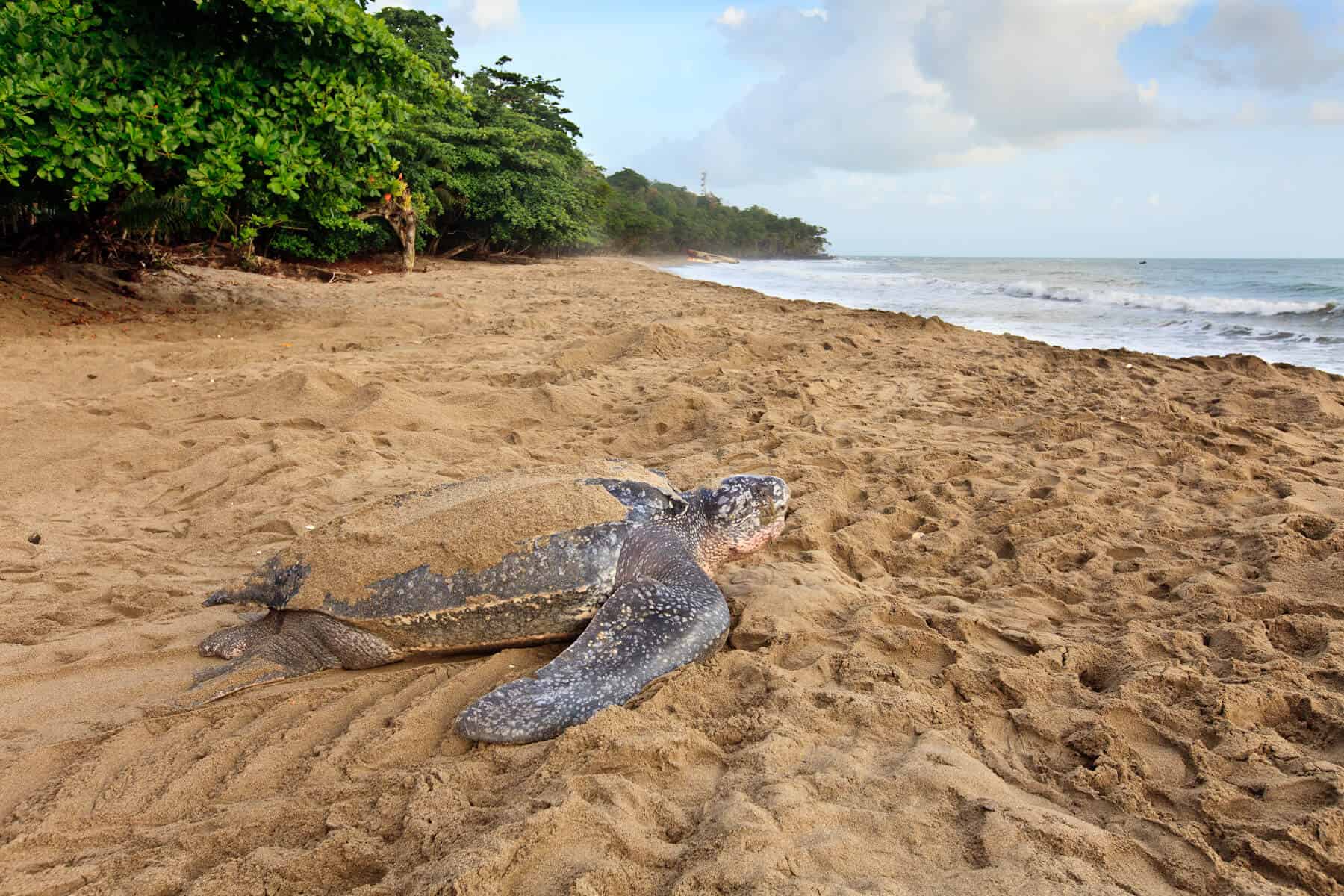
On the shores of Matura Beach, Trinidad, conservation comes alive after dark as volunteers assist local researchers in measuring, tagging, and monitoring nesting leatherback sea turtles. Photo by Ashleigh Bandimere
How Satellite Tagging Advances Science and Conservation
Sea turtles are fundamentally creatures of the open ocean. A female leatherback comes ashore to nest only every few years, then disappears back into the sea for long stretches at a time. What she does during those intervals was once almost entirely invisible to science. Satellite tags changed that.
When she surfaces to breathe, the tag transmits her location to a satellite network within hours. Over the course of a migration, this builds into a detailed record of her route, her speed, the ocean corridors she prefers, and the foraging grounds she’s been heading toward all along. That data shapes real conservation decisions such as fisheries management, marine protected area design, and international policy.
What these tracks reveal is the extraordinary scale of a leatherback’s world. Leatherbacks have the largest range of any reptile on Earth, nesting on tropical beaches from the Caribbean to West Africa and Indonesia before traveling thousands of miles to feeding grounds in the cold northern Atlantic and beyond. Some journeys extend as far south as the tip of Argentina. The longest recorded migration was 13,000 miles, one way.
A single leatherback may cross international boundaries and move through a patchwork of shipping lanes, fishing grounds, protected areas, and open ocean during her migration. Protecting an animal that travels such immense distances requires conservation that extends beyond any one coastline or country. When we protect leatherbacks, we also help safeguard the broader ocean habitats and wildlife connected to their journey.