I’ve made a habit of starting my mornings outside. Most days, that looks like walking my dog before the neighborhood fully wakes up. Other days, it’s just a cup of coffee on the porch. It doesn’t always happen. But when it does, the difference I notice is substantial.
It was something I tried to carry with me when the Oceanic Society team traveled to Nosara, Costa Rica, for our annual meeting to think bigger, reset, and reconnect to the work that brought us together.
Nosara has a way of making that easy. The air is unhurried. The people are deeply rooted in place and ritual. Wildlife is everywhere, with birds and howler monkeys announcing the morning before your alarm does. The roads are unpaved dirt, and somehow that feels intentional, too. The whole place reads like an open invitation to be more connected.
On one of those mornings, with some free time before the day started, I went for a color walk.
What Is a Color Walk, You Ask?
The concept is rudimentary. Before you step outside, you choose one color. Then you walk, slowly, and let that color lead you. You’re not trying to cover ground or reach a destination. You’re simply noticing every expression of that one color in the world around you.
It’s a mindfulness practice rooted in sensory attention, and is a simple way to reduce stress, sharpen observation skills, and invite presence. A way to make your eyes work before you ask your mind to.
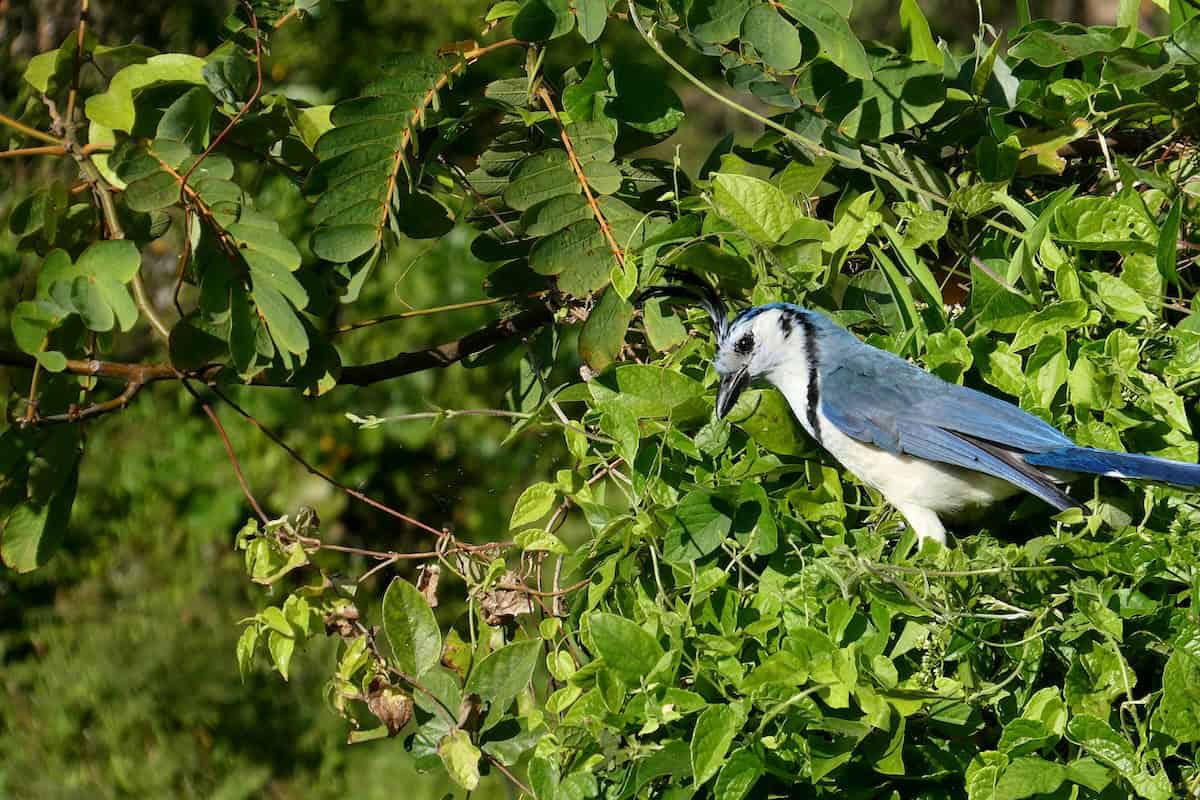
I chose green.
In retrospect, choosing green in the midst of a lush Costa Rican backdrop is almost cheating. But that’s also what made it pretty extraordinary.
Noticing Shades of Green
The first thing a color walk teaches you is that the color you chose doesn’t exist as a single shade. It fractures into dozens of variations the moment you start paying attention.
What stopped me first was a particular tree I hadn’t ever seen before. A mostly smooth, broad trunk, with hardly any branches below the crown, and interesting bark that seemed more like skin. Wide and wavy stripes ran vertically in colors I struggled to name. Not just green, but fern, forest, and a deep olive that faded to a lemon-lime hue. In contrast, a textured silver seemed to split the vibrancy.
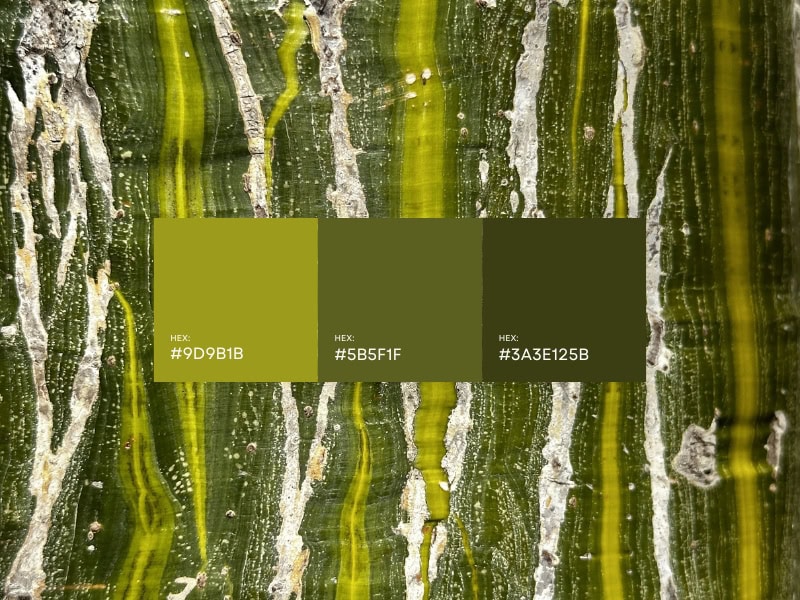
The photo I took doesn’t do it justice. In person, the whole trunk seemed to glow.
With much of today’s design trends and aesthetics leaning toward muted palettes, beige minimalism, and watered-down architecture, I felt particular relief being reminded that nature never got that memo.
I eventually learned that this beauty is known as the Ceibo Barrigón (Pseudobombax septenatum), a common tree along Costa Rica’s Pacific coast and one of the more quietly remarkable things growing in this part of the world. Its colorful stripes aren’t just decorative. They contain chlorophyll, and during the dry season, after shedding all leaves to conserve water, it continues photosynthesizing entirely through its bark. This species feeds itself through its own skin.
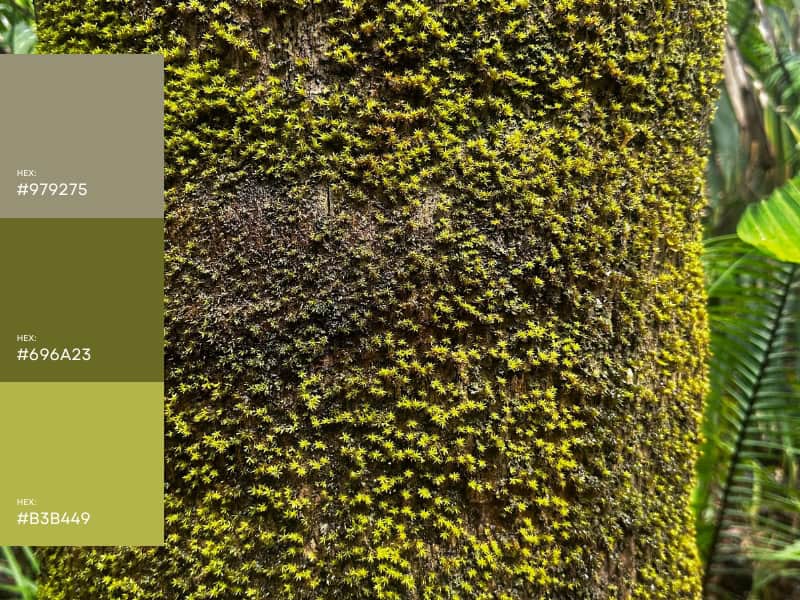
Then, on a moss-covered tree trunk along a walking trail, green became hundreds of tiny star-shaped spores, each one catching light like a miniature chartreuse explosion.
The texture was what first drew me in. Up close, it became an entire city. Tiny insects moved through the moss in every direction, each one seemingly on its way somewhere, each with some unspoken role to fulfill.
It makes you rethink how much life is constantly operating all around you, in overlooked corners, margins, and beneath your feet. In this case, an entire ecosystem was in a few square inches of bark. None of it is waiting to be noticed, but it’s there regardless.
I stayed longer than I expected here. I really loved this tree.
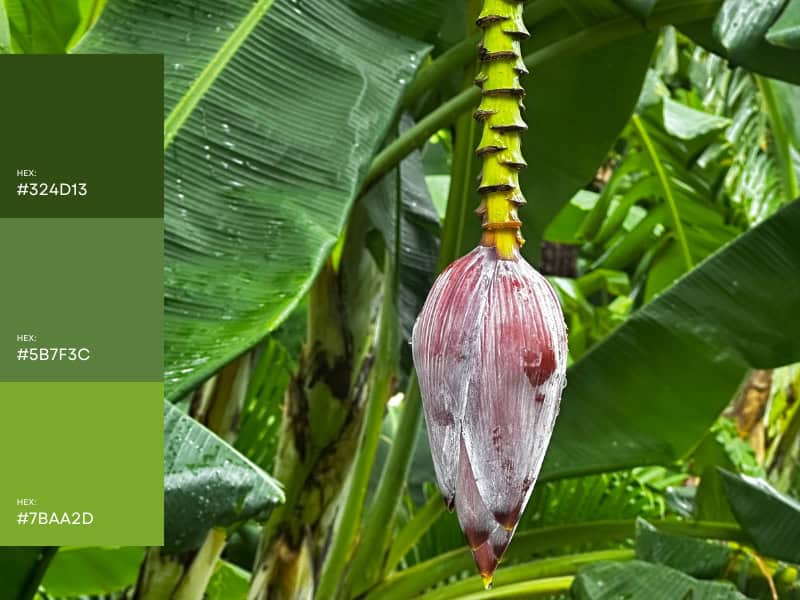
I turned a corner and spotted a deep, wine-dark banana blossom hanging heavy from its stalk, which oddly reminded me of asparagus. The plant itself was enormous, its leaves holding giant raindrops from the night before in its grooves and folds. The lines in each leaf radiated outward in long, soft lines from a central point, the edges curling and yielding to its environment.
I came to learn that Costa Rica is the third-largest banana exporter in the world. By some estimates, roughly one in ten bananas consumed globally comes from the country. And yet here was the flower that precedes it, hanging just above a dirt road this morning.
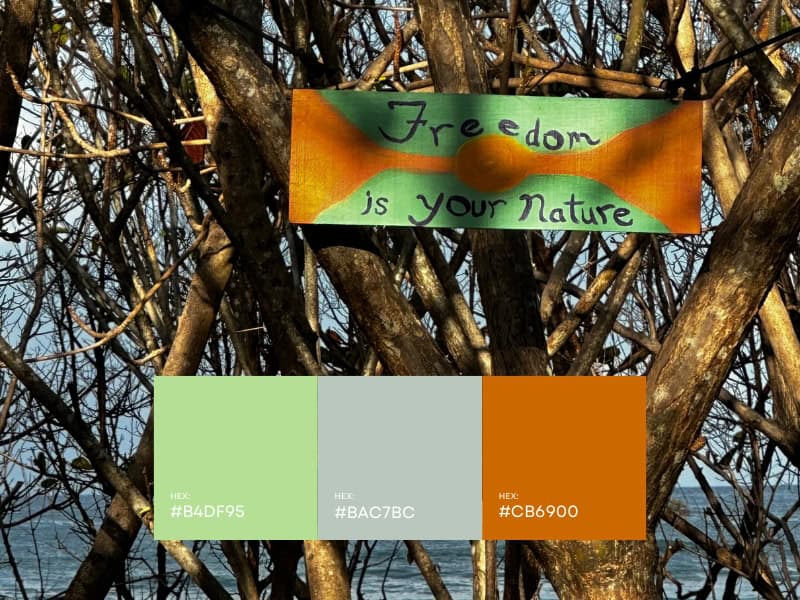
As I neared the beach, I came across a painted sign: Freedom is your nature. The seafoam and orange paint had weathered and sun-bleached, and it hung perfectly between bare branches. I’m not entirely sure I would have noticed it if I hadn’t already been in a state of looking.
Immediately, it reminded me of Koala Eco’s ethos, built around a similar phrase: More Nature, Feel Better. It sounds almost too simple. But then again, so does a color walk. The simplicity is the point.
We share the belief that time spent genuinely noticing the natural world is what moves people from passive observers to active stewards. And it’s one of the reasons Koala Eco’s partnership with the Oceanic Society is so aligned and authentic. Through their support of our Conservation Scholars Program, they’re helping make nature more accessible to the next generation of environmental stewards.
The Practice of Paying Attention
Oceanic Society’s mission, in a real sense, is to inspire people to care about the natural world. Much of that is best done through personal experiences and storytelling. That’s not something you can shortcut. It has to start with attention.
What research on nature connection consistently shows, and what we’ve seen in our own behavior change work, is that caring follows noticing.
It can be deeply challenging to feel truly connected to something you haven’t really seen. And most of us, most of the time, are moving too fast to see.
A color walk is one way to slow that down. It gives the mind a single task that is gentle, non-urgent, and impossible to fail at. In doing so, it quiets the noise long enough for genuine observation to happen.
View this post on Instagram
The Power of an Hour in Nature
Koala Eco’s Hour in Nature series is built on a radical premise: that one hour spent outside while truly present is enough to shift something in you. Not because one hour changes everything, but because presence compounds. The more you practice it, the more available it becomes.
A color walk fits naturally inside that hour. It doesn’t require gear, a trail, or a beautiful destination. It works on a neighborhood street just as well as on a dirt road in Nosara. The only requirement is that you actually look.
Before your next walk, even if it’s just around the block, choose a color and let it lead you.
Notice how many versions of it exist in a single stretch of sidewalk or trail. Notice what you would have stepped over without thinking. Notice how different familiar spaces feel when you move through them with a fresh perspective.