“I’m a manatee. I’m a manatee. I’m a manatee,” Nelson Lavin told himself as he floated at the surface of a quiet mangrove lagoon in Belize.
A dozen or so feet below, an Antillean manatee had just swum into view. These endangered creatures are rarely seen in the wild, but the mangroves of Belize offer one of the best opportunities in the world to swim alongside these giant herbivores, whose closest living relatives are elephants.
Before easing into the water from the dinghy, Oceanic Society guides had given their expedition group simple instructions: if you see a manatee, act like a manatee. No fast movements, no diving, no flapping arms or feet.
Generations of hunting and accidental boat strikes have made manatees wary of people. But in the right circumstances, like in the shadowy mangroves of Belize where they hide from predators and rear their young, they can also be curious. So Nelson floated motionless at the surface, feet pressed together like one big flipper, arms tucked to his sides, his dark wetsuit helping add to the disguise.

An Antillean manatee glides over the sandy seafloor near the Belize Barrier Reef.
For a moment, the strategy seemed to work. The manatee stared at him and drifted closer to the surface. “What are you doing up there, bro?” Nelson imagined the manatee thinking.
Eventually, the manatee spun away and swam out of view with a few powerful strokes of its tail.
For Nelson, a veteran ocean adventurer who has explored remote reaches of the world, the encounter fulfilled a long-held dream. “I have swum with dolphins and sea turtles, but never manatees,” he said, noting just how shocked he was by the size of the creatures, which can grow up to 12 feet long and weigh as much as a ton.
But swimming with manatees was just one highlight
of Nelson’s marine conservation volunteer expedition to Belize, based on St. George’s Caye, a mangrove island in the heart of the Belize Barrier Reef. The trip also gave him the chance to pursue a childhood dream of participating in marine research and discovering the jungle-shrouded ruins of ancient Maya civilization on the mainland.
A Longtime Passion for the Ocean
Growing up in Seattle near the Puget Sound, Nelson dreamed of becoming a marine biologist. Life and his career took a different path—today he works in the tech industry—but his passion for the ocean has never faded, inspiring him to travel extensively to places such as Fiji, Hawaii, and destinations throughout Central America.
When you are underwater, “the entire outside world is essentially cut off from you,” Nelson remarks, which helps him tune out the noise of everyday life. “You have to stay calm and focus on your breathing,” he says, which can put him in an almost meditative state.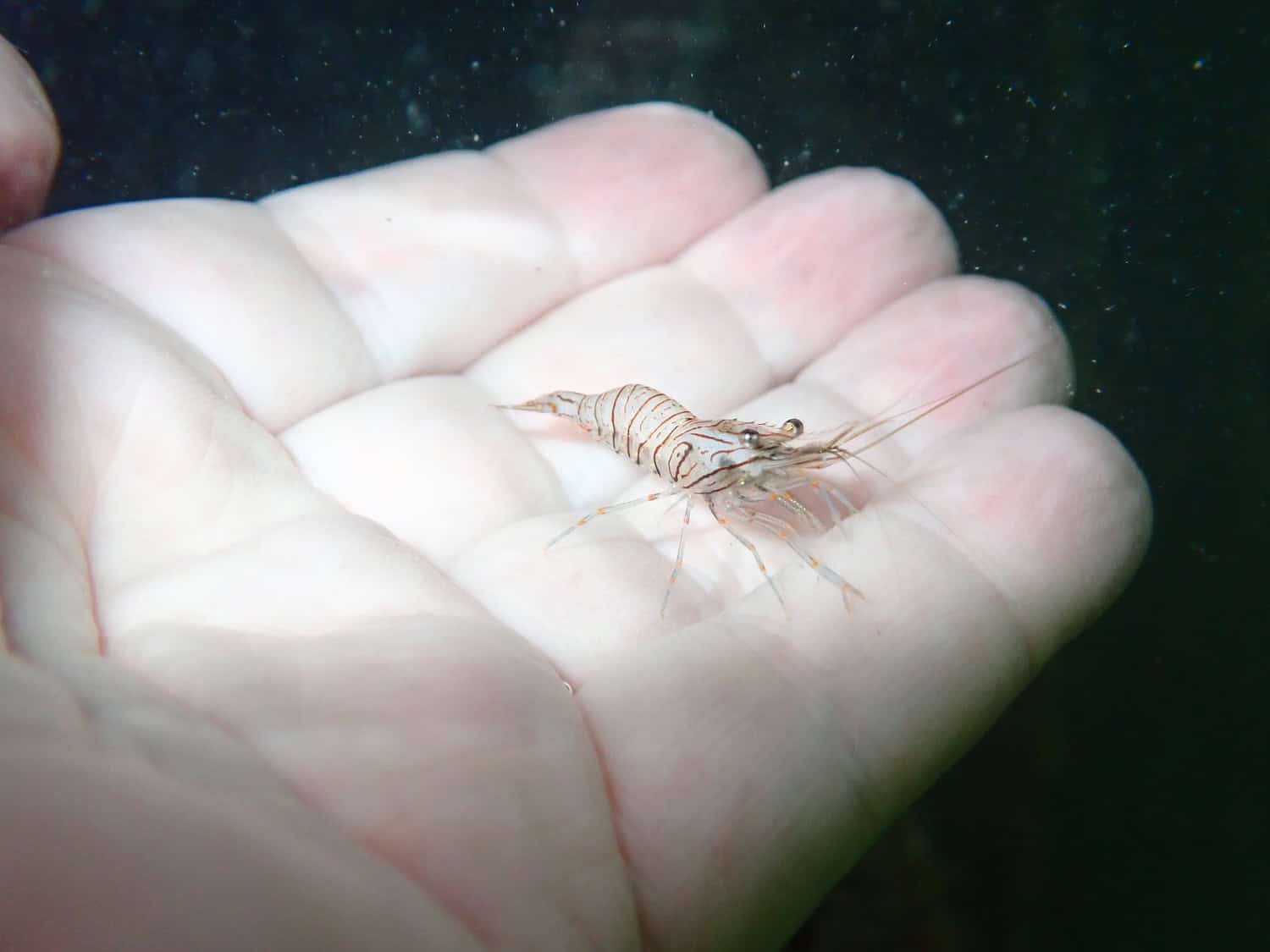
A small shrimp rests in Nelson’s palm, offering a close-up look at the intricate patterns and delicate features of Belize’s marine life.Despite his extensive travels, he has always wanted to explore his passion for marine biology more deeply. When he began looking into travel opportunities, he came across Oceanic Society’s volunteer expedition to Belize, where travelers work alongside researchers from ECOMAR at its research station and field school on St. George’s Caye. Volunteers help collect data on coral reefs, sea turtles, queen conch, dolphins, and manatees, contributing to ongoing research in an area that remains relatively understudied.
With few expectations and a healthy sense of adventure, Nelson set off on a solo trip to the island.
“Surprise me,” he thought.
Making a Difference Through Research
St. George’s Caye is an eight-mile boat ride off the coast of Belize City, but despite its proximity to the mainland, the surrounding waters remain relatively understudied.
Oceanic Society has a long history of supporting conservation in Belize, including operating a field station on Turneffe Atoll for more than 15 years. That work contributed to establishing permanent environmental protections in the area.
Founded by John and Linda Searle, ECOMAR has hosted volunteers at its research station since 1996. Its research documents the diversity of the surrounding marine ecosystem, from healthy coral reefs and endangered manatees and sea turtles to bottlenose dolphins and queen conch, which depend on local waters for important nursery habitat.
Oceanic Society volunteers help researchers collect data using a variety of scientific methods, which is then compiled into an annual report shared with the St. George’s Caye Village Council and Belize’s Fisheries Department. The data also helps establish a baseline understanding of the area’s marine life, supporting ECOMAR’s long-term goal of establishing one of Belize’s first underwater archaeological marine reserves.
Nelson’s fellow volunteers included other travelers like himself, alongside an intern from New York conducting ecological research and a Belizean veterinary technician helping care for Cupid, a green sea turtle undergoing rehabilitation at the research station. From the start, Nelson was struck by how accessible the work was. After a brief orientation, volunteers could contribute by recording wildlife observations, with no scientific background or specialized skills required.
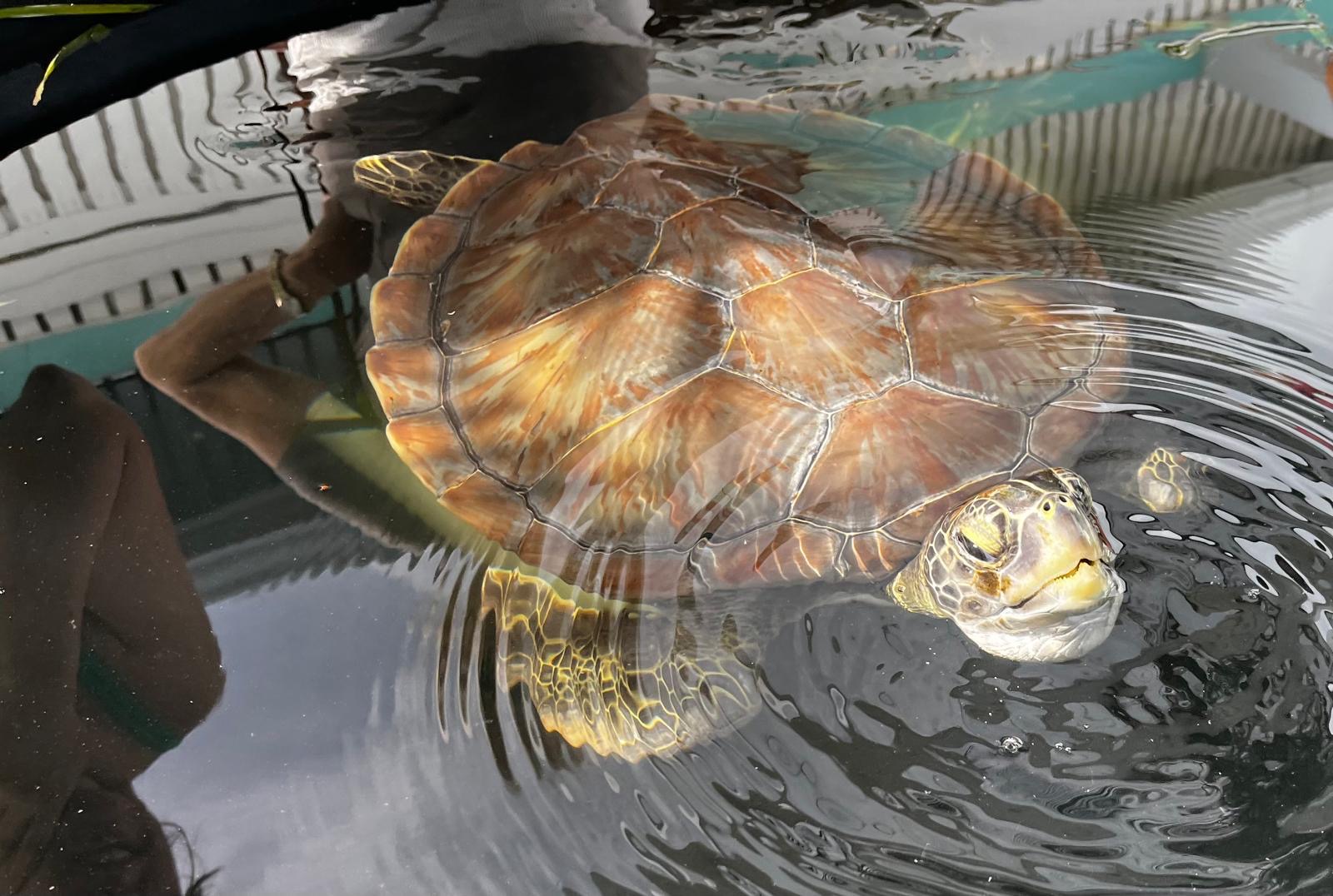
A green sea turtle receives care during rehabilitation at a marine research station in Belize.
“You didn’t have to come in with any skill level,” he says.
One species that they focused on documenting was the queen conch, a large sea snail known for its distinctive shell. Queen conches play a crucial ecological role, feeding on algae and helping prevent overgrowth that can choke other marine life. They also serve as prey for predators, like sharks, sea turtles, and eagle rays.
Queen conch are also important to Belize’s fishing industry, making it important to monitor their populations and protect the seagrass habitats where they live.
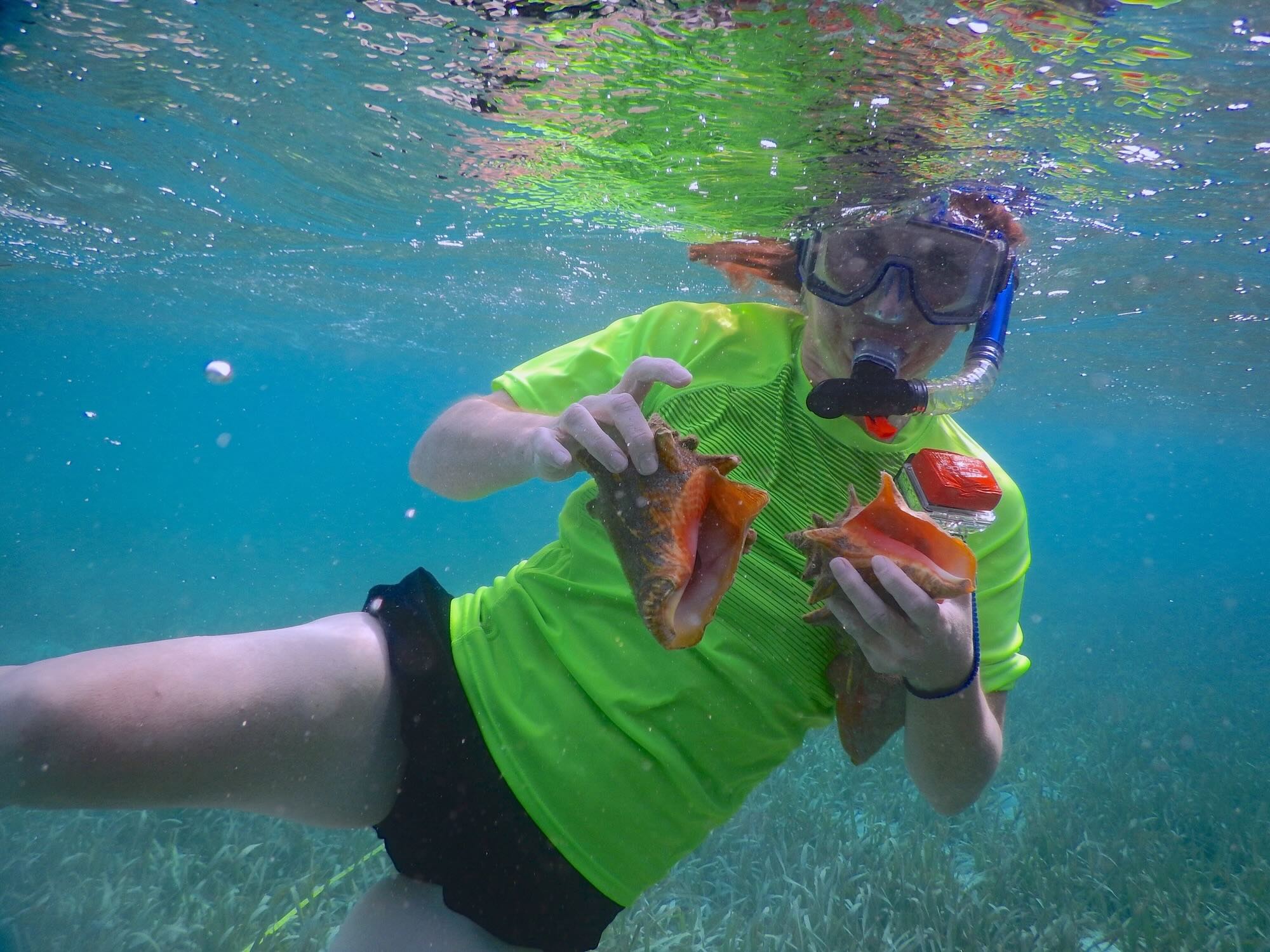
A snorkeler examines queen conch shells in the waters around Belize, where ECOMAR conducts surveys to monitor conch populations in seagrass habitats. Photo by ECOMAR.
But demand for conch meat and shells has put pressure on these populations. To help monitor them, researchers survey conch in seagrass beds, measuring each shell’s length and lip thickness before returning the animals to the water. These measurements help researchers understand the population and assess the maturity of individual conch, providing information that can support fisheries management.
“These surveys contribute to whether or not they feel they should open the [fishing] season early or close the season early,” explains Nelson. The group also documented other marine life, including lionfish, an invasive species in the Caribbean. Knowing that their observations contributed to scientific research gave the work a tangible sense of purpose.
For Nelson, the work was especially meaningful. It offered a chance to put his longstanding interest in marine biology into practice.
When they weren’t surveying wildlife, Nelson and his fellow volunteers explored the surrounding waters with Linda, whose deep connections to the local community opened the door to experiences visitors might otherwise miss. During a day trip to Hol Chan Marine Reserve, they explored the area’s diverse marine habitats, including mangrove forests. She showed them where to look for manatees and introduced them to the surprisingly diverse ecosystem.
“Let’s stick our head in a whole bunch of roots,” Nelson laughed at the encouragement to snorkel in what felt like the heart of a jungle, where the web-like roots of mangroves drip like tentacles into the water. “It turns out all of those roots end up looking like just coral environments,” and these shadowy roots were home to reclusive animals, like seahorses.
The expedition also left plenty of time to enjoy the underwater world without collecting data. During free-snorkeling opportunities, volunteers could explore the reefs and encounter marine life such as nurse sharks, colorful reef fish, and shrimp. For Nelson, the combination of hands-on research and time simply observing the surrounding ecosystem made the experience especially rewarding.
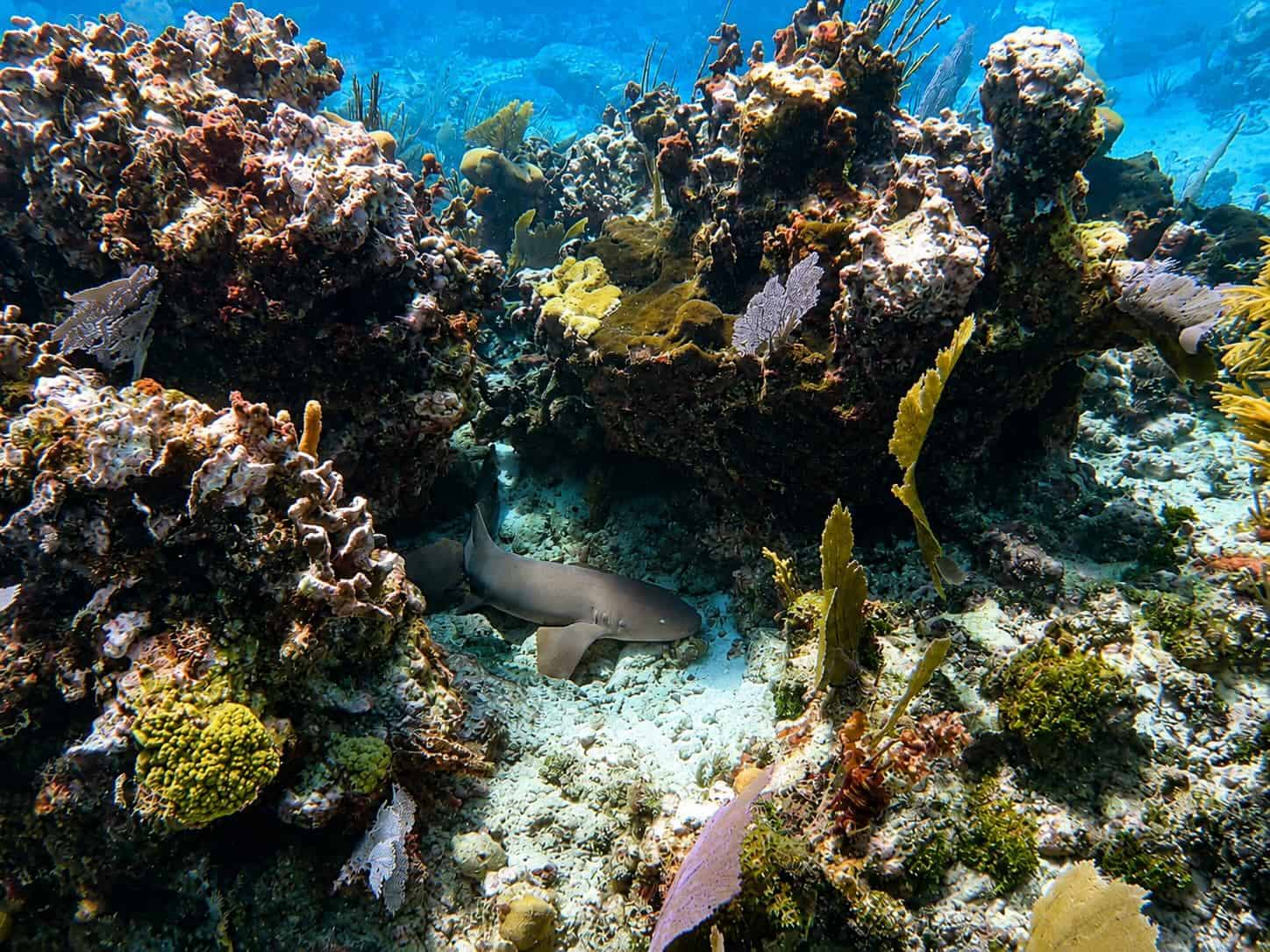
Nurse shark sleeping among coral formations. Photo by traveler Nelson Lavin.
Discovering Belize’s Ancient Maya History
Nelson’s expedition offered plenty of surprises beneath the surface, but he decided to extend his time in Belize to explore what awaited on land, too. He added Oceanic Society’s Belize Maya Ruins & Rainforest Extension, where he discovered just how deeply Maya history is woven into the landscape of Belize and neighboring Guatemala.
Historians estimate that at the peak of the Mayan empire, up to 2 million people lived in Belize. Today, Belize hosts a quarter of that figure, but the ruins of this formerly vast empire are seemingly everywhere.
Tikal offered a different glimpse into ancient Maya civilization, with towering stone temples and monumental plazas rising above the surrounding rainforest. Walking among the ruins gave Nelson a chance to explore the history and architecture of one of the Maya world’s most significant ancient cities.

The towering temples of Tikal rise above the treetops in Guatemala, offering a glimpse into the ancient Maya civilization.
On the drive to Actun Tunichil Muknal, a renowned cave with Mayan ruins in Belize, his guides pointed out farm fields that were built directly over Mayan ruins. A bump in the dirt road, they explained, could have been the foundation of a house. Then, in the distance, small islands of trees would rise from expanses of cornfields— but they were left standing because the ruins beneath them couldn’t be plowed. “There’s just ruins everywhere,” he says.

Sunlight filters through the jungle canopy into the clear waters of Actun Tunichil Muknal, a cave system in Belize known for its archaeological significance and underground swimming passages.
Inside the cave, the past felt even closer. Access is tightly controlled, with only about 125 visitors allowed per day, and no cameras permitted. After a long hike and a swim to reach the entrance, Nelson found himself standing just two feet from ancient pottery and skeletons left by the Maya. “How are we allowed here?” he remembers asking himself.
“This is stuff that you have only seen in National Geographic.”
The Freedom to Explore
Nelson usually travels with his wife, so exploring Belize without her was a little bittersweet.
“Boy, I really wish she we’re there,” he says. But the trip showed him how rewarding it can be to travel solo as part of a group.
“There was the right amount of structure. I never felt like I needed to worry about anything,” he says. With the logistics taken care of and knowledgeable guides leading the way, Nelson could settle into the experience without worrying about the details.
That balance gave Nelson the freedom to effortlessly explore Belize and Guatemala, from snorkeling among mangrove roots to discovering ancient Maya ruins.
And with a group of fellow travelers who shared his interest in ocean conservation, connections came naturally.
“It kind of just brought you together as a group,” he explains. “Our impact on the environment is significant. And if we can help it in any way, we all wanted to.”