This article was originally published by the State of the World’s Sea Turtles (SWOT)
On September 16, 2026, the first documented sea turtle nest in Southern California was recorded. An olive ridley sea turtle was filmed (see below) in broad daylight near Seal Beach, Orange County (about 30 miles south of downtown Los Angeles), digging her nest and laying eggs.
The event sparked excitement and speculation both within and beyond the sea turtle community, as it marks a significant departure from the species’ normal range. The eastern Pacific population of olive ridleys is abundant, nesting in Panama, Costa Rica, Nicaragua, and Mexico, as far north as Baja California, but never before in the United States. A few days later, a second olive ridley came ashore in Orange County to lay a nest as well.
Since they were laid, both clutches were collected by researchers and relocated to the nearby Aquarium of the Pacific to finish incubating. This decision was made ahead of the coming storm set to hit the Southern California coast, bringing high tides and aggressive wave action that would have put the nests at risk of inundation and/or erosion.
This summer has been a remarkable year for wildlife in Southern California. An ocean heat wave, compounded by a strong El Niño and powerful swells, has brought unusual visitors to local waters, including whale sharks, longfin bigeye fish, spinetail devil rays, hammerhead sharks, and birds like the waved albatross.
These events raise many questions: are sea turtles shifting their range in response to climate change? Have recent storms in the region disoriented nesting females? Could this become a more common occurrence?
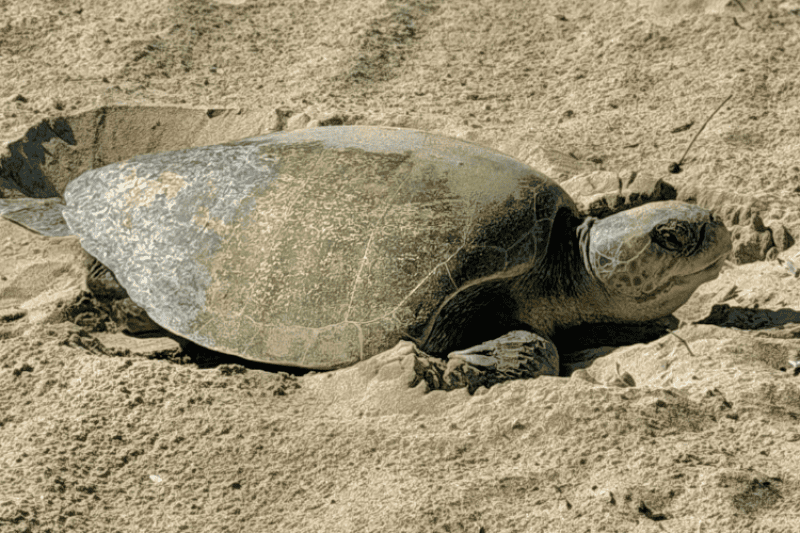
An olive ridley sea turtle nests near Seal Beach in Huntington Beach, California, far outside its normal nesting range. © Huntington Beach Fire Department
We posed these questions to Southern California sea turtle expert and NOAA Fisheries scientist Jeff Seminoff and U.S. Fish and Wildlife Service’s marine turtle expert Ann Marie Lauritsen:
What might explain why these sea turtles nested in Southern California?
JS: While the exact reasons are not certain, it is reasonable to believe that the warm ocean conditions tied to the forecasted El Niño played a significant role. Much of the southern California region is experiencing tropical-like conditions and these have sustained for several months, perhaps opening a thermal corridor—think of a warm-water bridge—that makes California accessible to tropical species coming in from the high seas. Olive ridleys are extremely flexible in how they live their lives and opportunistic in what they eat, and this adaptable lifestyle may have somehow contributed to the nesting events. It is also possible that the two turtles lost their way, thinking they were closer to their natal nesting beaches, due to some sort of navigational malfunction. Finally, and significantly, a big factor here is that there are many more olive ridleys living in the Pacific Ocean today thanks to protections from the U.S. Endangered Species Act; actions such as bycatch reduction and habitat protection play huge roles in helping olive ridleys recover, and with more turtles in our oceans it elevates the possibilities of seeing more turtles in more places doing things we’ve never seen them do before, such as nesting in southern California.
AML: Countries within this olive ridley population’s range have made important progress in reducing threats, especially through bycatch‑reduction measures such as incorporating Turtle Excluder Devices (TEDs) in trawl fisheries and improving other fishing practices. These efforts directly reduce mortality at sea. These two nesting events are a great reminder why continued support for sea turtle conservation remains essential. The Inter-American Convention for the Protection and Conservation of Sea Turtles (IAC) brings countries across the Americas together to coordinate science‑based conservation, strengthens protection along migratory routes, and ensures that gains in one nation benefit the species across its entire range. In addition, programs like the Marine Turtle Conservation Fund support habitat protection, threat reduction, and the partnerships needed to sustain long‑term recovery. Together, these conservation measures improve our ability to safeguard sea turtles into the future.
Do you think this was a one-time occurrence triggered by recent ocean and climate conditions in the region, or a potential range shift for the species?
JS: While we know tropicalization of temperate habitats is occurring around the world, this is more likely an isolated event ultimately tied to the unusually warm waters. However, if marine heat waves and warming phenomena increase in frequency and severity, it is possible and perhaps likely that we will see additional olive ridley nesting on southern California’s beaches.
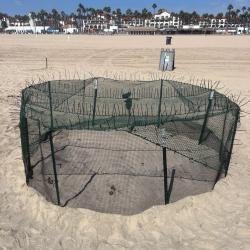
A protective fence was erected around the olive ridley nests to protect them from beachgoers and predators. © NOAA Fisheries
Is Southern California suitable habitat for sea turtle nesting?
JS: There are two answers to that question. In terms of beach structure and sand characteristics, southern California beaches are very similar in form to known olive ridley nesting beaches in Mexico. However, the limiting factor for suitability in this case is temperature. What we consider a ‘normal’ for weather conditions in our region are generally not warm enough to sustain egg development and hatching success. However, as ocean and beach conditions change through time, it is possible that in the future, local conditions will be more conducive to nest success.
AML: Rare or unusual nesting events do occur, and when they do, they provide an opportunity to prepare for nesting in places where it has not previously been documented. We do this by coordination with states, counties, and municipalities to reduce the effects of artificial lighting, beach driving, and other activities that may affect nests and hatchlings. The goal is to support communities in sharing the beach with sea turtles while maintaining the natural nesting and hatching process.
If these eggs hatch, could the hatchlings that survive to adulthood return to Southern California to nest?
JS: Everything we know about sea turtles would suggest yes, with an asterisk. That is, ocean conditions would need to be sufficiently warm to sustain a healthy living for any olive ridley returning to California to nest. Adding to the uncertainty is that with so few eggs (204 between the two nests) and the anticipated low hatching success, there will be long odds that even a single turtle would survive to adulthood.
Does this raise any conservation concerns?
JS: My colleagues at U.S. Fish & Wildlife are better suited to address this question. Recall that sea turtles living in our local waters here in the United States are federally managed under NOAA, the agency I work for. When a turtle crawls out of the ocean for nesting then it is federally managed by the U.S. Fish & Wildlife Service. That same is true of any eggs or hatchlings that result from the nesting event. Even so, the presence of turtles on the beach also demands added attention and resources from local life guards and law enforcement agencies for things like nest protection, crowd management, and beach safety. In that context, it is reasonable to say that having nesting sea turtles on southern California’s beaches has and will continue to draw major attention from local, State, and Federal agencies, as well as the local law enforcement agencies and municipal governments that are adjacent to the nesting sites.
AML: These unusual nesting events do prompt questions about any environmental changes that are occurring, particularly because these nesting events fall quite a bit outside the species’ typical nesting range. Our recovery approach continues to emphasize nest protection in situ using the least manipulative strategies, even under these unusual circumstances. Looking ahead, our focus will be on assessing beach conditions to protect nests and monitoring outcomes so that future decisions continue to support natural nesting processes.
Can you explain the process for incubating the clutches ex-situ and what will happen to the hatchlings when they hatch?
JS: The process of incubating the eggs from these two nests is consistent with the best practices used at many olive ridley nesting beaches throughout Pacific Mexico. Eggs and nearby sand from each nests were placed into separate insulated cooler boxes and transported to the Aquarium of the Pacific where they are currently maintained at a constant temperature in a climate-controlled room. My colleagues at U.S. Fish & Wildlife Service would be better able to answer the question about hatchling management, as they are the managing authority for this effort.
AML: Depending on water temperature, any hatchlings that emerge will be released as soon as possible after dark to conserve their brief frenzy period. This frenzy period is a burst of vigorous swimming that helps them escape predator‑rich nearshore waters.
What do you think people should take away from this event?
JS: There’s no question this is an amazing and unprecedented natural event in southern California. However, the true context of these two nests won’t be known for years. Will they be viewed as a natural oddity, or are these nests the first of many more to come? Only time will tell.
AML: We can share the beach with sea turtles. Whether these nests remain an unusual occurrence or become part of a broader pattern, the way forward is to prepare together: protect nests where they are laid, address human-causing threats to nesting habitat, and coordinate early with wildlife agencies, organizations, and the public. These first documented nesting events offer an opportunity to build that shared approach before the next nest.