More than 600 sea turtle experts from around the world gathered in Kailua-Kona, Hawaiʻi, in February 2026 for the 44th International Sea Turtle Society Symposium (ISTS), a global meeting focused on advancing sea turtle research and conservation. Throughout the conference, one theme consistently emerged: the complex ways humans shape sea turtle populations and their habitats.
Increasingly, conservationists are recognizing that protecting species cannot be separated from understanding people. Researchers who once focused primarily on population dynamics and ecology are now integrating social science into their work and recognizing that sustainable conservation outcomes depend on human behavior as much as biological knowledge.
To help address this gap between intertwined disciplines, Oceanic Society’s State of the World’s Sea Turtles team and social scientists from Human Nature Group formed Team BEACH (Be A Change Maker). Team BEACH brings together conservation practitioners and social scientists to integrate behavior change strategies into conservation work, equipping the global sea turtle community with tools to better understand and influence the human behaviors impacting marine life.
For the fourth consecutive year, Team BEACH hosted a behavior change training workshop at ISTS, led by behavior change experts Rachel Smith and Kelly Anderson (Human Nature Group). The hands-on workshop introduced participants to key social science concepts and guided them through applying these tools to real-world conservation challenges.
A Practical Framework for Behavior Change
At the core of the workshop is a simple but effective framework developed by Team BEACH:
- What behavior needs to change?
- Who is the target audience?
- Why is the behavior happening?
- How can we influence it?
This exercise helps conservationists focus on actionable behaviors and design strategies that are tailored to the people and communities involved. This was applied in real-time to active conservation challenges submitted by projects around the world.
2026 Conservation Case Studies
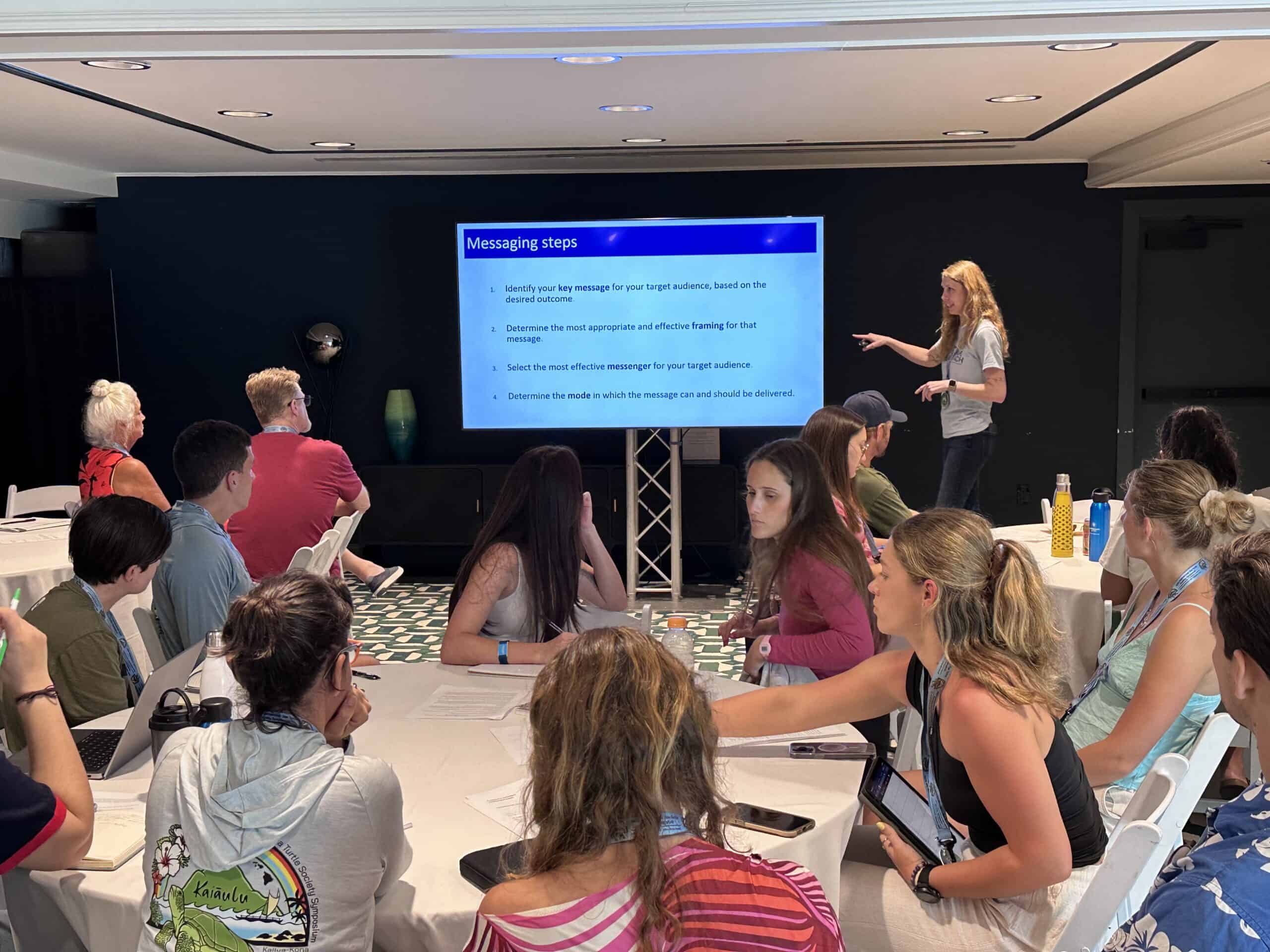
Participants engage in a Team BEACH workshop at the 44th International Sea Turtle Society Symposium in Kona, Hawaiʻi, where experts guide sea turtle conservationists through practical messaging steps to influence human behavior for more effective species protection.
Venezuela: Eliminating Illegal Sea Turtle Harvest in the Gulf of Paria
- Project Partners: FUDENA, Provita, and Venezuela’s Ministry of Environment (MINEC)
- The Challenge: In the Gulf of Paria, fishers illegally capture critically endangered hawksbill sea turtles and harvest their eggs.
- Understanding the Why: These practices are often tied to livelihood needs and longstanding cultural traditions, making them difficult to address through enforcement alone.
- Workshop Discussion: Participants explored how to shift community norms and align conservation goals with local values, developing strategies that consider both economic realities and social dynamics.
Kenya: Reducing Sea Turtle Bycatch in Artisanal Fisheries
- Project Partners: Coastal Sustainable Environmental and Economic Development (COSEED)
- The Challenge: Along Kenya’s northern coast, artisanal gillnet fisheries overlap with critical habitats for green and hawksbill turtles, leading to both accidental capture and entanglement.
- Understanding the Why: Fishing practices, economic pressures, and limited alternatives all contribute to continued interactions with turtles and a barrier to the adoption of new gear and strategies that would limit bycatch.
- Workshop Discussion: Participants developed behavior change strategies focused on influencing fishing practices, exploring incentives, awareness campaigns, and community-led solutions to reduce sea turtle bycatch.
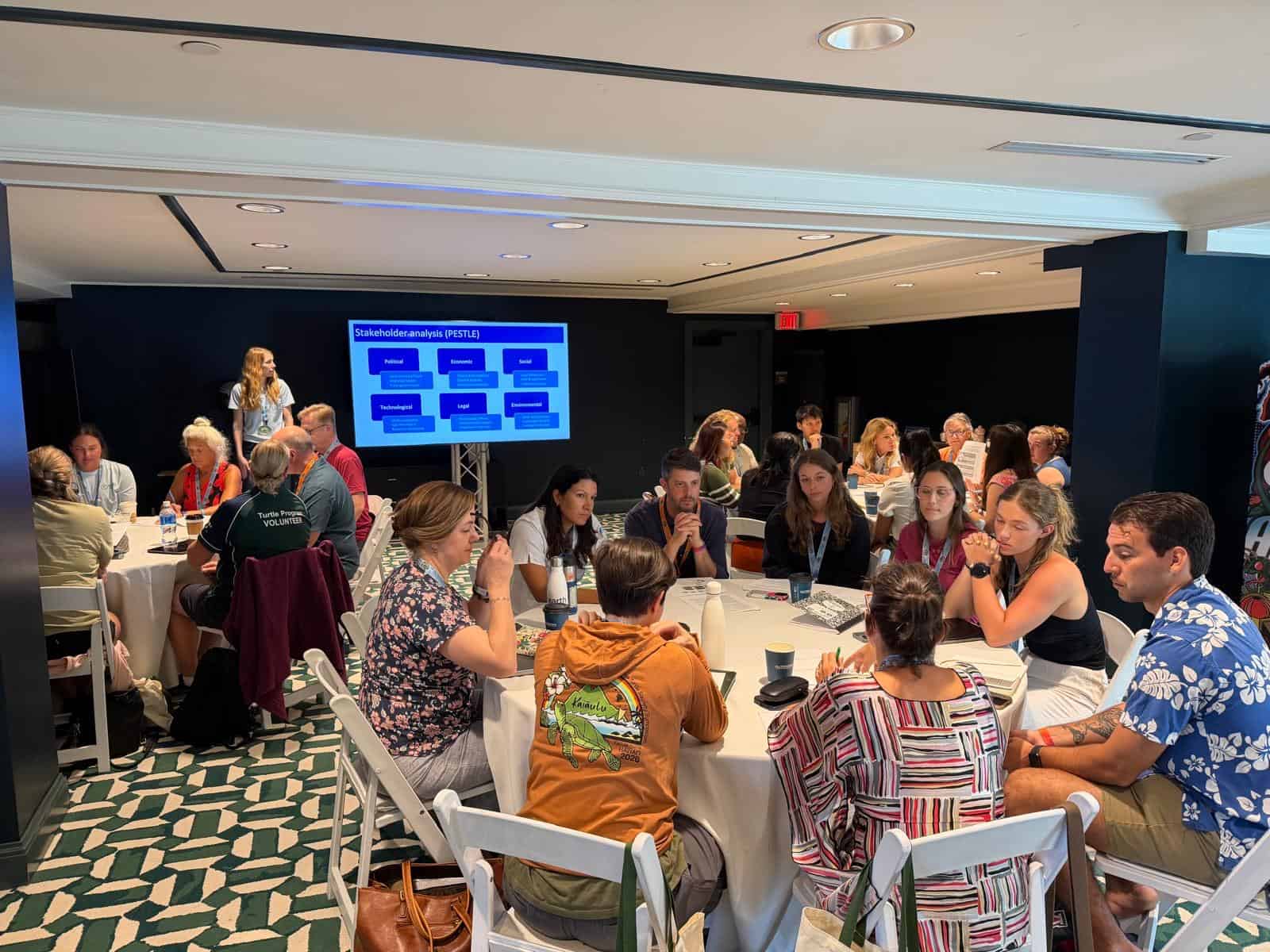
Workshop participants conduct a stakeholder analysis using the PESTLE framework to explore the political, economic, social, technological, legal, and environmental factors shaping conservation challenges.
California, United States: Reporting Turtle Entanglements in Urban Fisheries
- The Challenge: At the San Gabriel River in Los Angeles, a popular urban fishing site, green sea turtles are frequently entangled in fishing lines. This project seeks to encourage fishers to report entangled turtles to the NOAA stranding hotline.
- Understanding the Why: Fishers often lack awareness of where or how to report, may not recognize when a turtle is in distress, face practical obstacles like limited phone access, and have little immediate incentive to act.
- Workshop Discussion: Participants focused on reducing friction and designing strategies to make reporting easier, more visible, and more intuitive for the local fishing community.
Equipping Conservationists with Tools That Work
By the end of the workshop, participants had developed tailored behavior change strategies for each case. Attendees left with practical tools they could apply to their own work, while projects that submitted case studies will receive these developed strategies to adapt and implement within their communities.
The impact of the session was perhaps best captured by participants themselves:
“You [presented behavior change] in a way that applied to everyone. One of the biggest challenges in community conservation is applying universal, often Western, frameworks to complex, place-specific issues.”
“This workshop changed my perspective on behavior and how to systematically investigate audiences… I’m excited to bring this back to my colleagues and share it with them.”
As conservation continues to evolve, integrating social science is no longer optional; it is essential. Team BEACH is helping equip the global sea turtle community with the tools needed to meet that challenge.
Learn more about Team BEACH and access resources from this and previous workshops here.