While cruising through Loreto Bay National Park, a UNESCO World Heritage Site known for its exceptional diversity of marine mammals, Maria Nájera, a naturalist and co-founder of Whales of Loreto, thought she saw a humpback whale breaching in the distance.
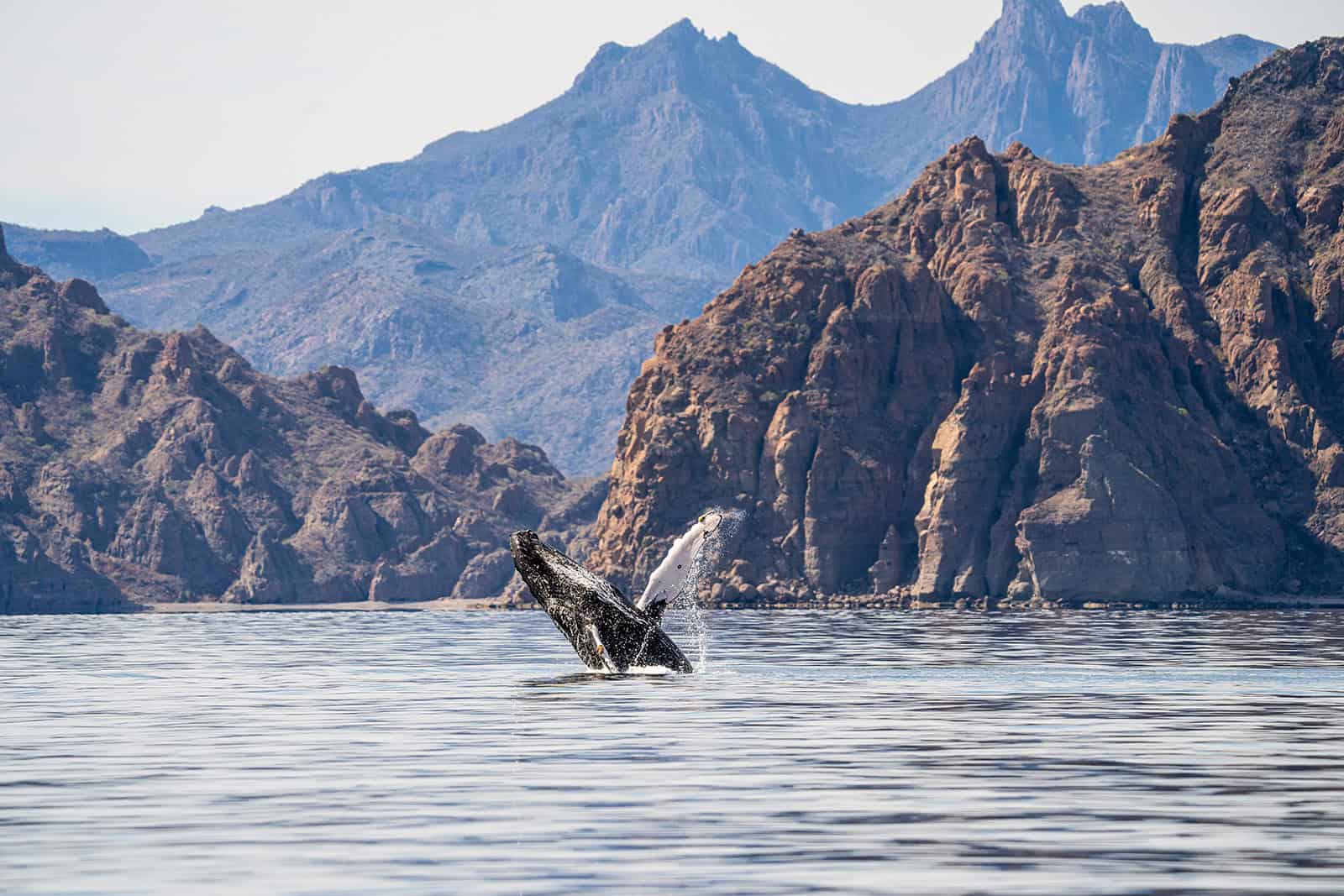
Airborne humpbacks are a common sight in the Sea of Cortez, a narrow gulf tucked between the Baja California peninsula and Mexico’s mainland. But as Maria and her crew approached and the whale breached again, spinning through the air, it became clear they were looking at something far rarer: a blue whale, the largest animal to have ever lived on Earth.
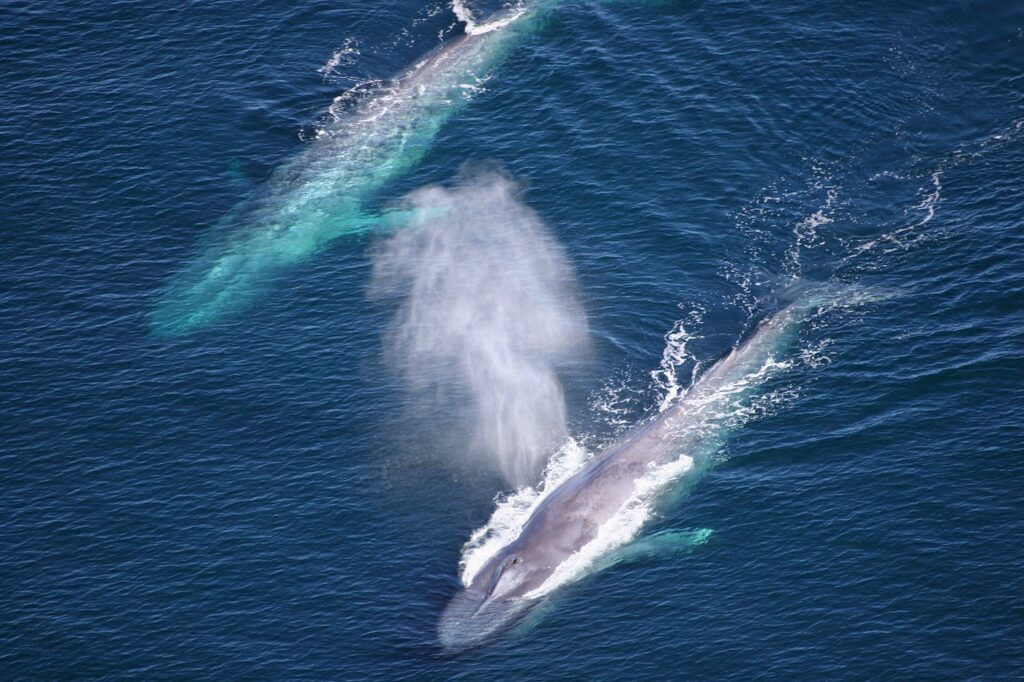
To see a blue whale breach at all is extraordinary. To see one breach repeatedly, lifting a body that can weigh more than 200 tons and stretch over 100 feet out of the water, borders on the unimaginable.
“It was like 180 tons of animal coming out of the water,” describes Maria as she watched the blue whale spiral out of the water several more times.
But the show wasn’t over. As they approached, she directed the crew to turn off the engine and wait so as not to disturb the whale. Then, a blow from the blue whale erupted just six feet away from their panga, soaring more than 30 feet high. Its massive frame drifted underneath them, close enough that Maria could see the details on the whale’s face before it disappeared into the deep.
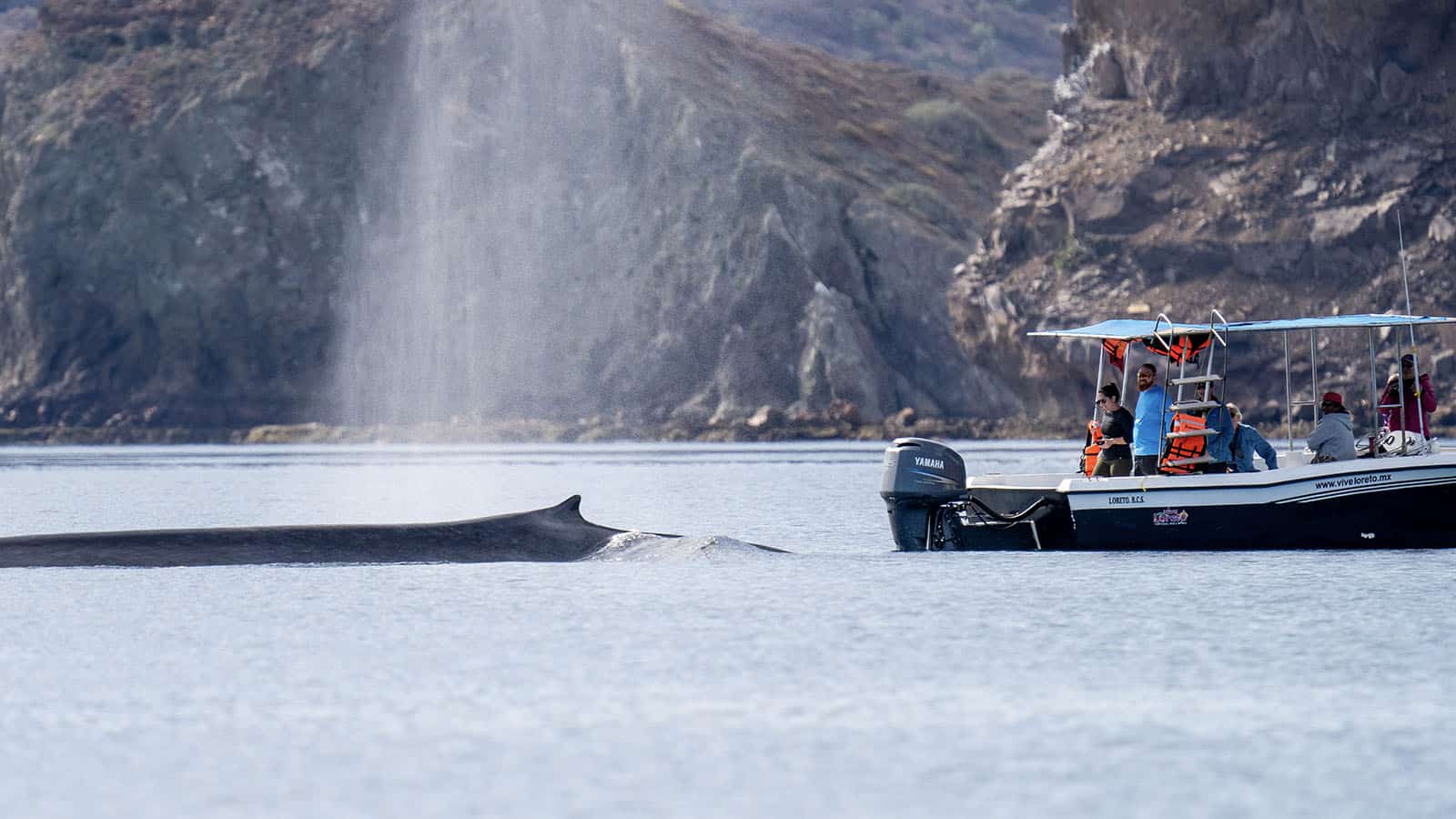
The massive size of this blue whale is evident next to whale watchers. © Chris Biertuempfel
What struck her wasn’t just the spectacle. It was the mood of it. The whale wasn’t fleeing. It wasn’t startled. It was, in some way, at ease.
“They feel relaxed, that they can do whatever they want—that they can be wild,” she explains, “This makes us realize that we are doing the right thing.”
What Maria is referring to is a whale watching technique she and her team have been using, which seemingly defies conventional logic: by giving whales ample space and respecting their boundaries, travelers are more likely to experience close encounters with these remarkable ocean giants.
Maria Nájera (left), co-founder of Whales of Loreto, has spent two decades training local boat captains in the passive whale watching method — an approach rooted in patience, respect, and the long-term well-being of the whales she has dedicated her life to protecting.
From Environmental Exploitation to Appreciation
For much of its history, Loreto—a small fishing town in Baja California tucked between the red Sierra de la Giganta mountains and the turquoise waters of the Sea of Cortez—had no particular relationship with whales beyond the occasional sighting from shore.
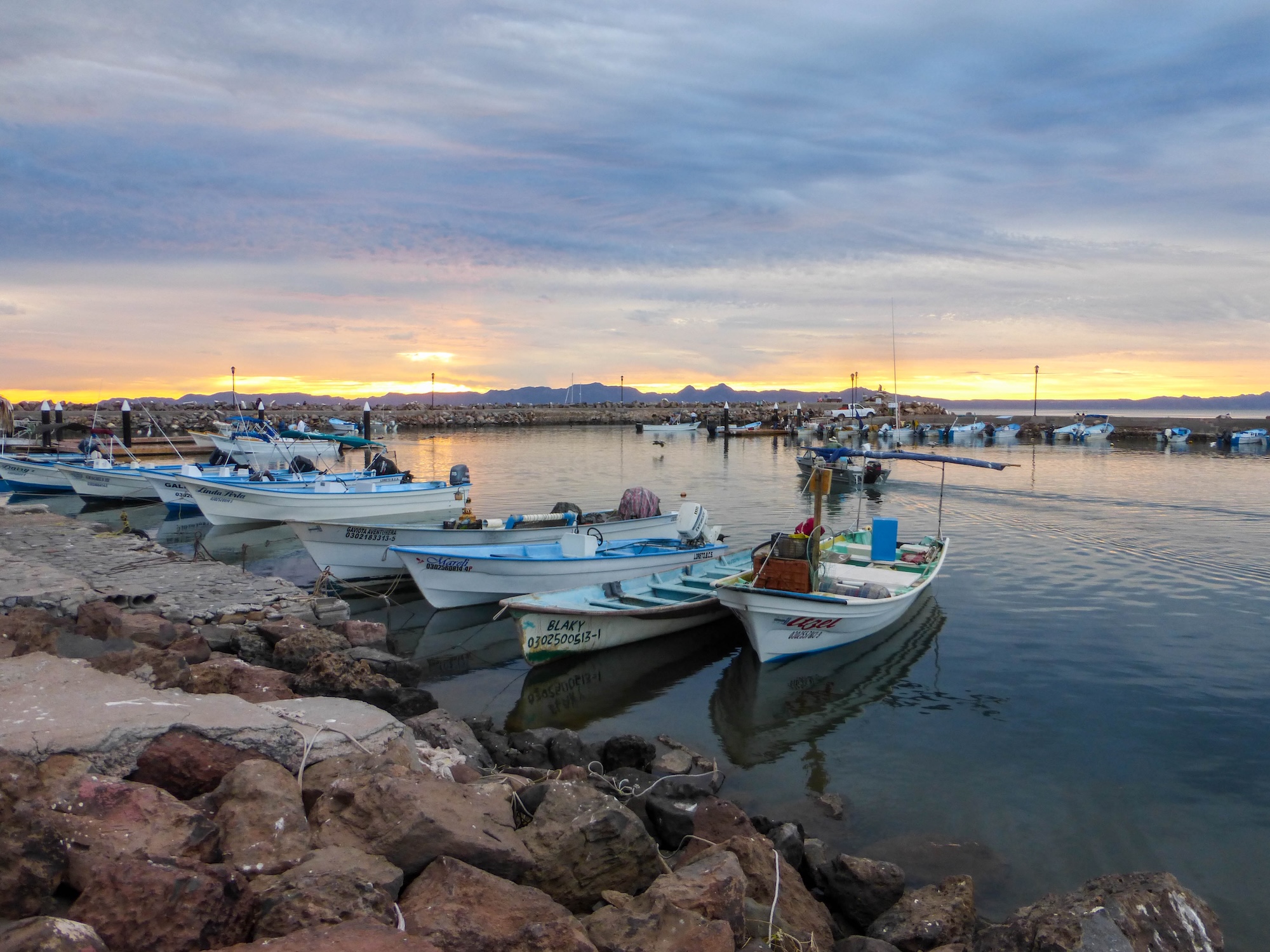
Fishing pangas line the harbor at sunset in Loreto, Baja California — a town where generations of families built their livelihoods on the Sea of Cortez. Many of these same boats and captains have since traded nets for nature tours, making whale watching a cornerstone of the local economy. © Roger Harris
For generations, fishing was the primary industry here, driven by high demand for mahi-mahi, yellowtail, and sailfish. Livelihoods were earned through extraction.
What changed the equation was protection. The establishment of Loreto Bay National Park in 1996 carved out environmental safeguards that gave the ecosystem room to recover and, in doing so, created conditions for a new kind of economy to emerge. Ecotourism began to take hold in the years that followed, drawing travelers from around the world to experience one of the most biologically rich marine ecosystems on the planet.
Each year, ocean currents draw krill up from the deep, creating a blanket of maroon on the surface of the water. The abundance of krill is a major reason why many baleen whales, like blue whales and humpbacks, converge in the Sea of Cortez to feed. But it’s the presence of krill on the surface that creates one of the most dramatic wildlife encounters in the world, as whales can often be seen erupting through swarms as they feed.
This is one reason why Loreto Bay National Park is considered one of the most reliable destinations in the world for seeing blue whales, of which scientists estimate that only 15,000 remain in the world.
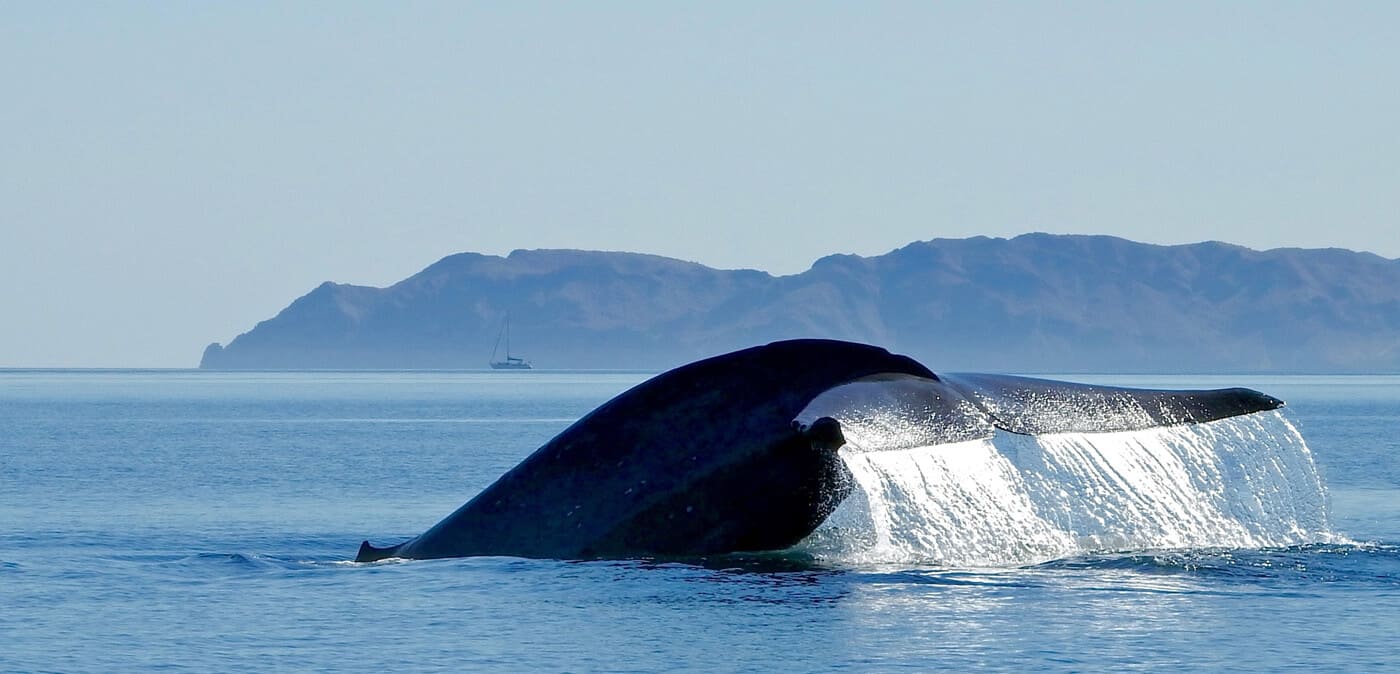
The large flukes of a blue whale near Loreto. © Roger Harris
It was during this economic transition to ecotourism that Maria and her husband, Rafa, arrived in Loreto, roughly twenty years ago, having left Mexico City in pursuit of something closer to the natural world. What they found was an industry with tremendous potential and a significant problem.
“They were chasing [the whales],” Maria says of the fishermen who had taken up whale watching as a side income between fishing seasons. “They didn’t know how to approach them.”
The Art of the “Passive Method”
Chasing whales is, counterintuitively, among the most self-defeating practices in whale watching. It frightens the animals, causing them to abandon feeding, mating, and critical socialization moments. The disturbance also causes them to expend precious energy needed for long migrations and leads to more frequent vessel strikes—a leading cause of death for many vulnerable whale species. A whale that feels threatened simply dives and disappears.
“It really stresses them out, especially with the bigger boats,” describes Maria, who has spent the last twenty years studying whale behavior.
Maria understood this instinctively. But it was the arrival of Dr. Diane Gendron, a cetacean researcher based at CICIMAR-IPN in La Paz, and one of the world’s foremost experts on blue whales in the Gulf of California, who gave the approach scientific grounding and a replicable framework. Her proposed solution was called the “passive method,” a whale-watching technique that she hoped would protect whales while still leading to incredible encounters.
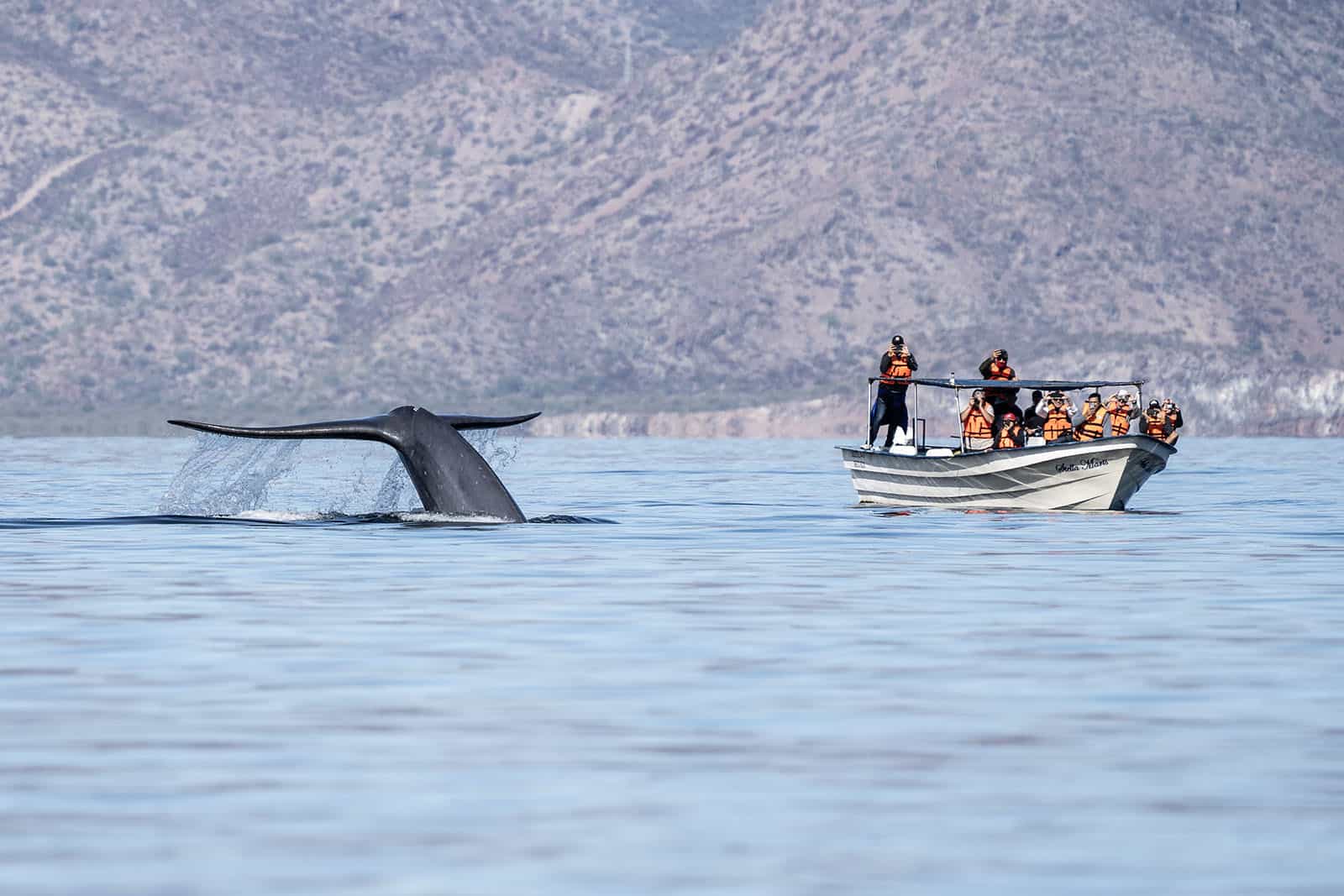
A blue whale surfaces near whale watchers in the Sea of Cortez. © Chris Biertuempfel
The concept is simple: instead of chasing whales, tour operators watch for blow holes and study the movements of the whales before carefully approaching. When they believe they are within 100 meters (about 328 feet), they turn off the engines and drift across the water, waiting patiently to see if the whale decides to engage with them. If it doesn’t, the boat moves on without pursuit.
This approach means wildlife encounters happen on the terms of the animals, which is a pillar for ethical ecotourism that ensures the environments humans appreciate are left unharmed.
What makes it counterintuitive is what it asks of human psychology: patience, restraint, and a willingness to accept that the encounter might not happen on your terms, or at all. Tour operators, conditioned to guarantee sightings, sometimes find this difficult to embrace.
When Maria heard about Diane’s research, she was immediately intrigued by its potential and teamed up to see if it would work, starting in 2012. They found that with the passive approach, whales’ activity became even more predictable—they no longer fled feeding grounds and seemed undisturbed by whale watching pangas, even if there were several in the same place.
The passive method not only led to closer interactions with whales but also to more frequent encounters. She describes how using the method has led to pods of humpback whales brushing against their whale watching pangas—a very rare behavior usually only seen with gray whales in places like the San Ignacio Lagoon.
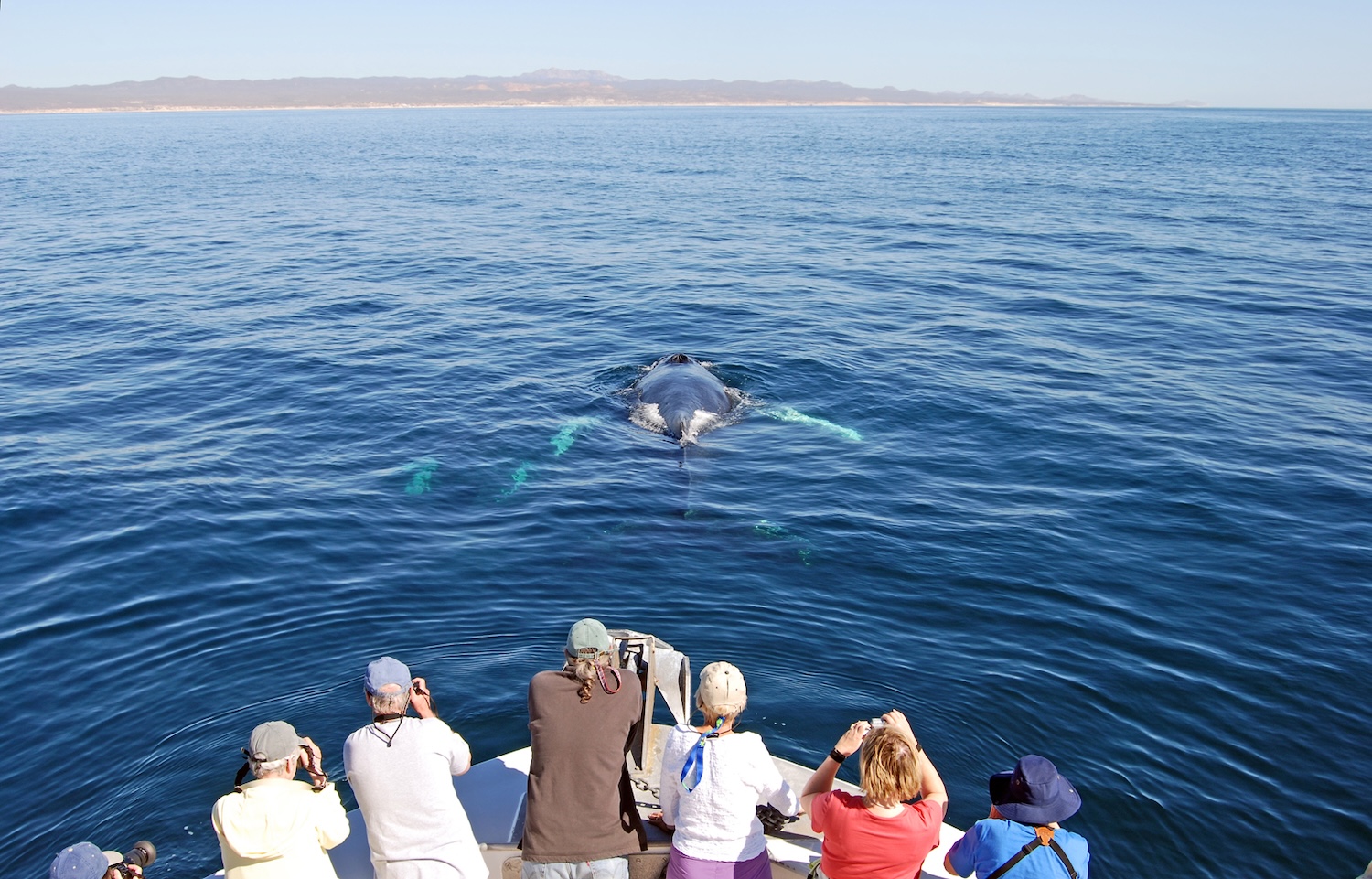
Travelers at the bow watch a humpback whale surface just feet away — a close encounter made possible by the passive whale watching method. © Izzy Szczepaniak
“Humpbacks are like teenagers,” she laughs, “You never know what they’re going to do.”
Blue whales are a different story. In Loreto, Maria sees the same individuals return year after year, often mothers with their calves. She’s come to recognize them on sight, noting their markings and behaviors as they pass through these waters again and again.
“They are telling the other whales that it is good to come,” she says with a wink.
Building a Grassroots Movement
As news of the passive method’s potential spread, intrigue grew among the local fishermen community leading whale watching tours around Loreto.
“If you talk to the commercial fishermen, they’re very tough, and they’re always in a hurry,” she says. That mindset initially led many captains to chase whales, believing it was the quickest way to guarantee sightings for customers. But Maria soon discovered that the fishermen were also open-minded and curious. When captains saw that a more passive approach resulted in longer, closer, and more natural encounters than chasing ever had, the shift happened naturally.
Over the years, Maria and her team at Whales of Loreto have trained generations of boat captains in how to read whale behavior: the signs of distress, patterns of movement, when to kill the engine, and when to wait. The training has accumulated into something that now functions as a community standard.
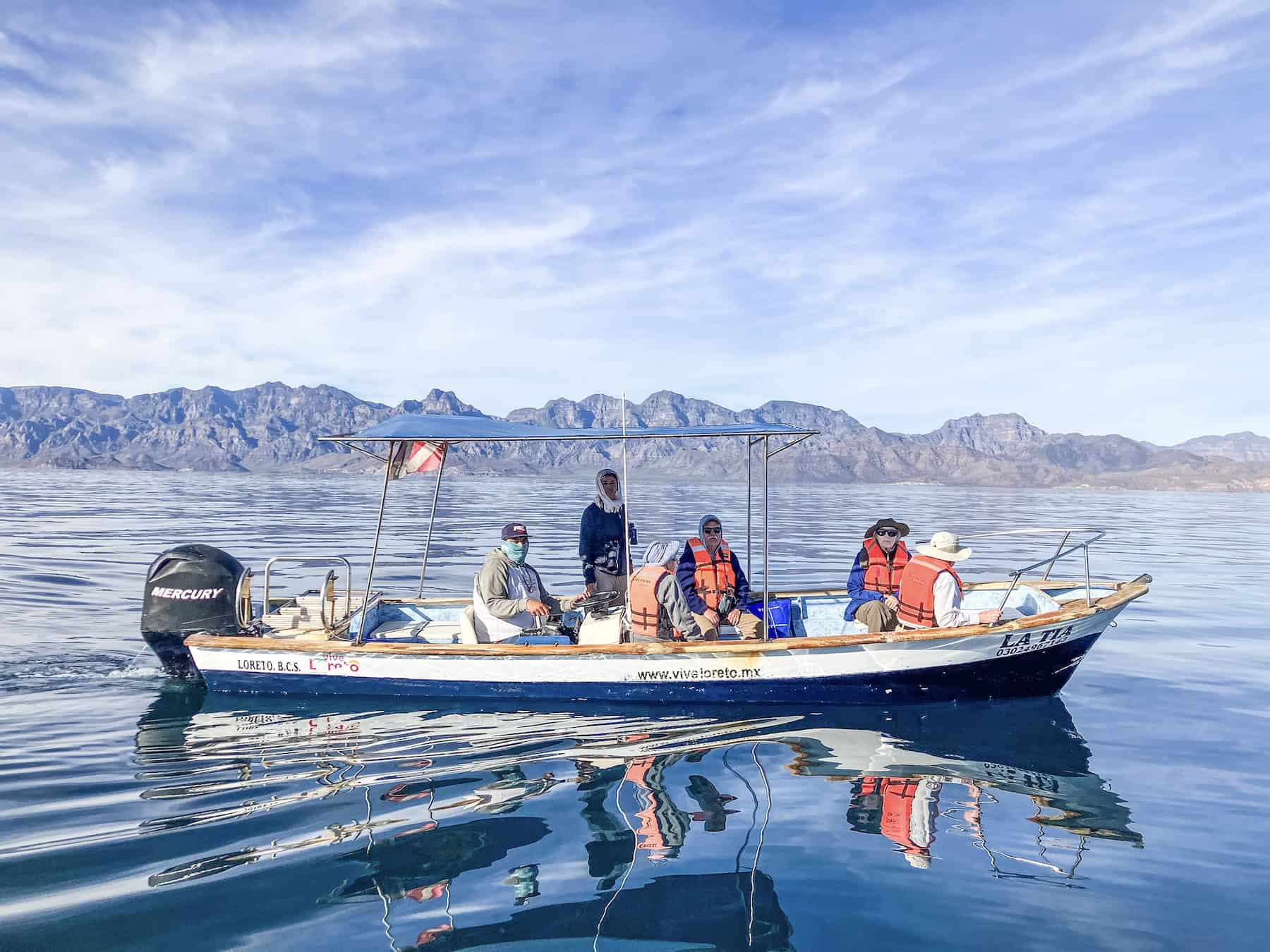
Maria Nájera and her husband Rafa scan the glassy waters of Loreto Bay National Park with guests, watching for the telltale blow of a whale — the first sign that it’s time to quietly cut the engine and let the passive method work its magic. © Chris Biertuempfel
According to Maria, whale-watching operators throughout Loreto have now largely shifted their approach to the passive method through their training program. For many tour operators, whale-watching has grown from a side-hustle run between fishing seasons into a crucial pillar of their livelihood. While unregulated tourism can harm the environment, the passive method of whale-watching best embodies how ecotourism can successfully fuse livelihoods with protecting wildlife.
This personal economic transformation experienced by local fishermen is also reflected across the community. Rising demand for whale-watching in Loreto has driven the development of restaurants, hotels, and other businesses tied to whale-watching. Underpinning much of this growth is the healthy presence of whales, which the community has grown dependent on.
Today, Maria describes that the community in Loreto has become fiercely protective of the local whales, which include fin, minke, humpback, blue, gray whales, and others. When a whale watching panga is seen not abiding by the passive method or chasing whales, fishermen will radio them, urging them to stop.
This is not legally mandated. No regulation requires it. It is a community enforcing its own values because those values now correspond to its economic survival. That kind of self-governance is extraordinarily difficult to manufacture from the outside, and nearly impossible to sustain without the economic stake that makes it worth defending.
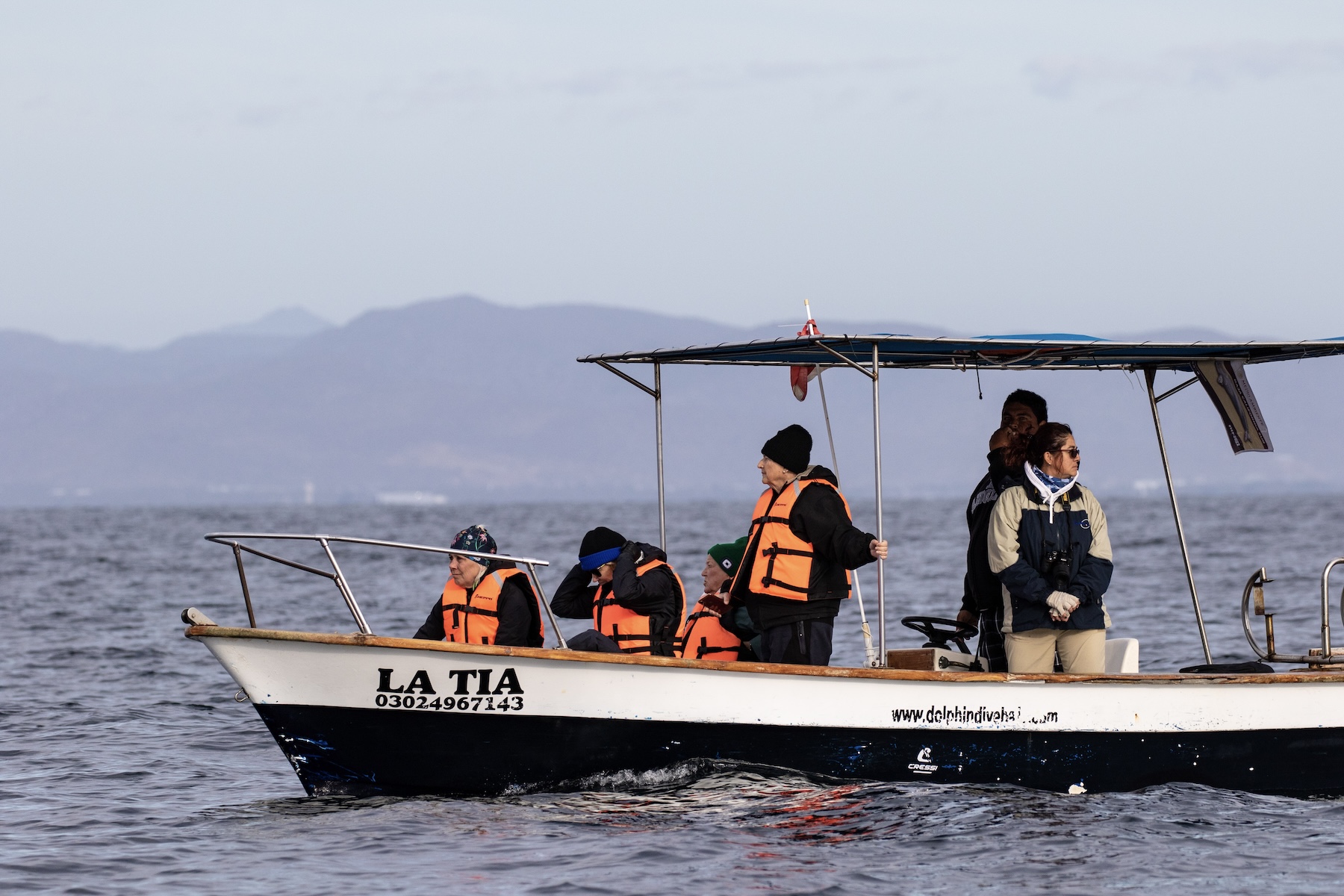
No regulation requires operators here to follow the passive method, but in Loreto, it has become an unspoken code that the community enforces on its own. © Chris Biertuempfel
Whales of Loreto, who sit on the advisory committee for the Loreto National Park, are advocating for it to become law. But even as chasing whales has been mitigated with local tour operators in Loreto, new challenges threatening whales have arisen—and require the same grassroots efforts to repel them.
A Partnership with Shared Values
Since 2014, Oceanic Society has partnered with the Whales of Loreto on expeditions to the Sea of Cortez, united by a shared commitment to responsible ecotourism, ethical whale-watching practices, and community-based conservation in Loreto Bay National Park.
Guests joining an Oceanic Society expedition to Loreto will head out on the water with Whales of Loreto, often alongside Maria and her team trained in passive whale-watching techniques. Cruising through the stunning land and seascape of Loreto Bay National Park, guests benefit from guides who have spent years studying whale behavior and understand how to engage these sensitive animals responsibly, always prioritizing their well-being and natural behavior.
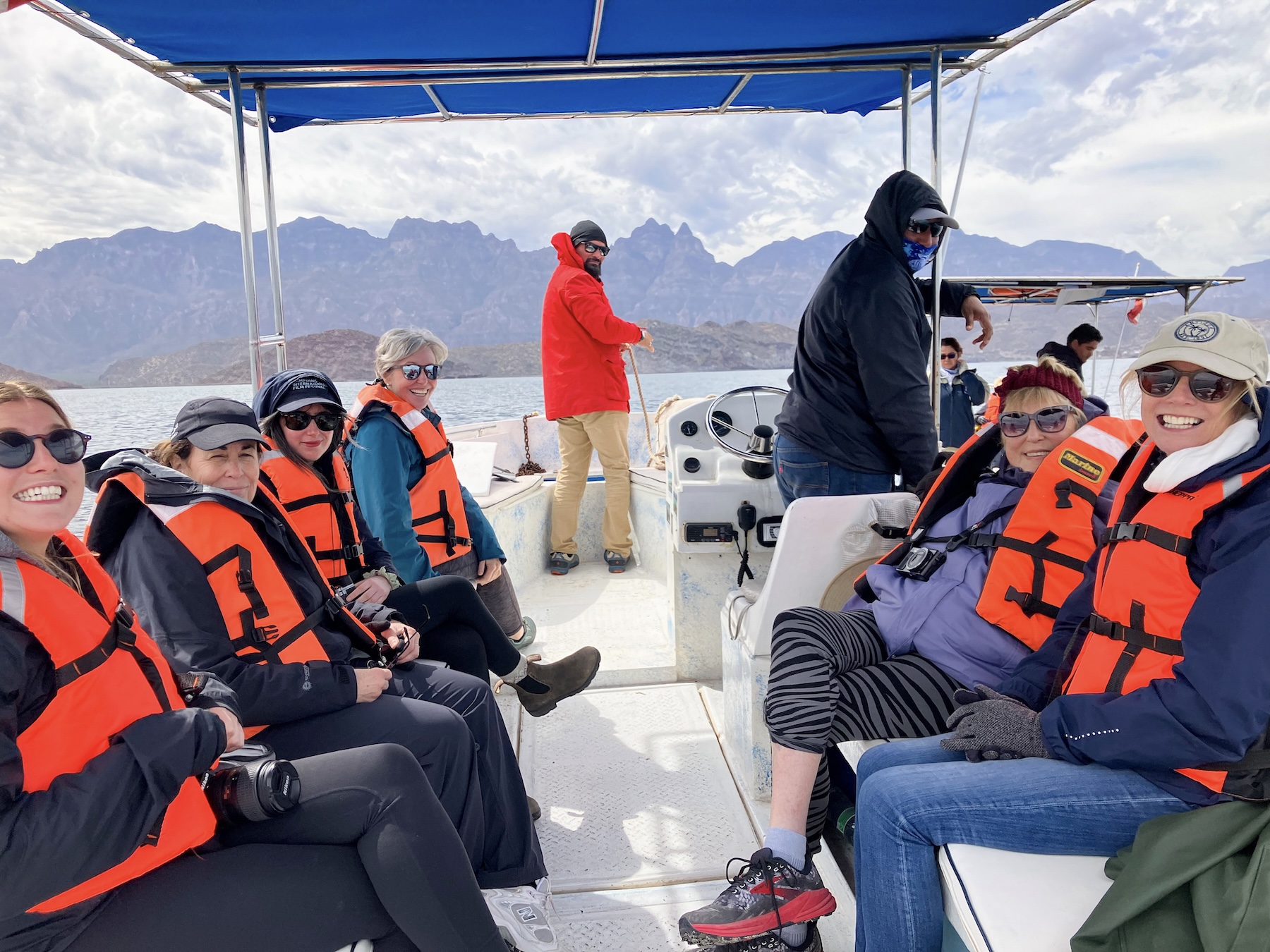
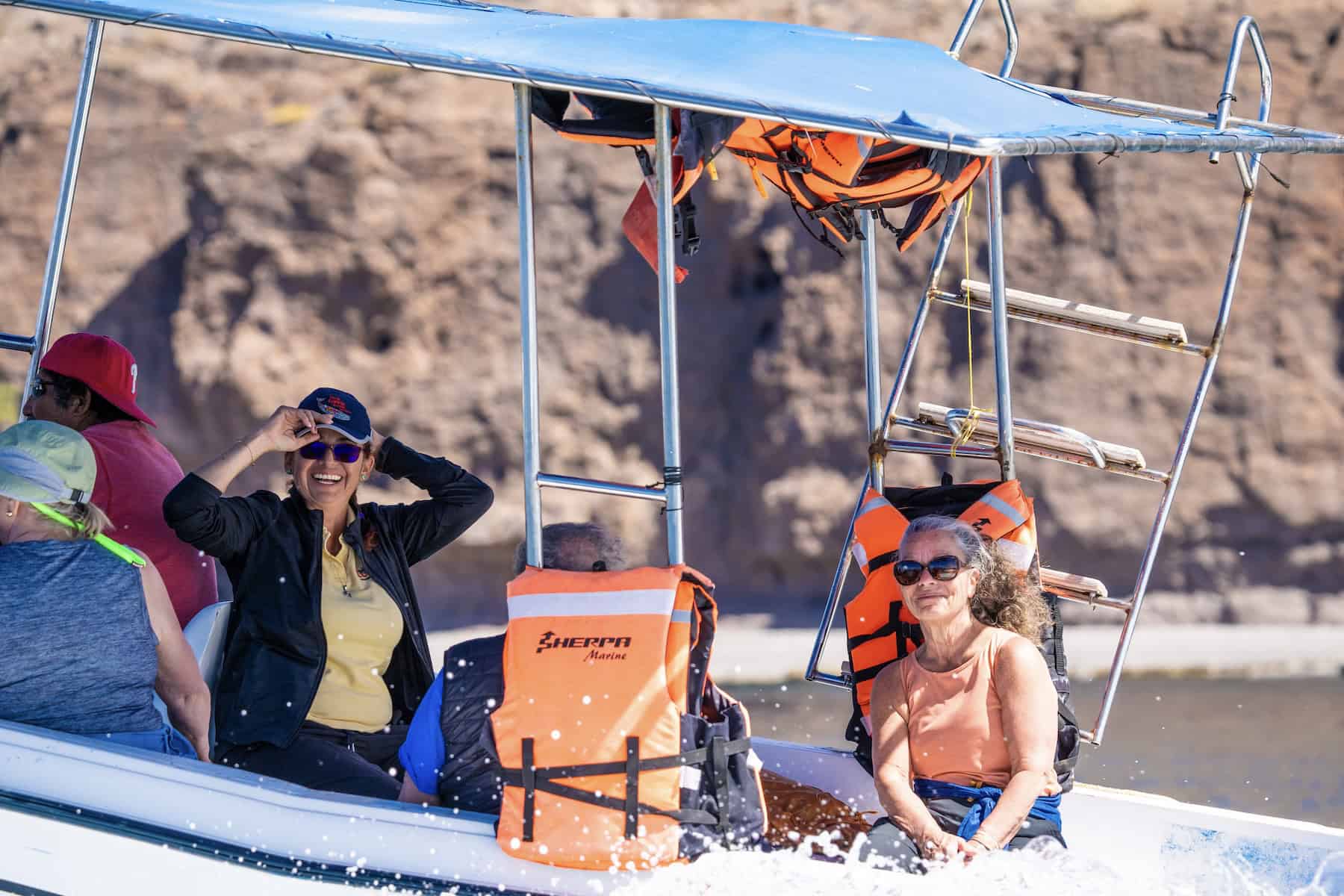
Smiles on board: Oceanic Society travelers head out for a morning whale watch in Loreto Bay National Park with Whales of Loreto. © Chris Biertuempfel
Partnering with local tour operators is a core tenet of Oceanic Society’s mission. Not only do local partnerships ensure that the funds brought by tourism actually benefit the host community and help shift the economy to one that values the environment, but they also mean collaborating with guides who understand the nuanced sensitivities of the local wildlife and how to protect it.
Protecting an Ecological Treasure
Today, the community Maria helped build is being tested.
The Mexican government has relaxed controls on the number of cruise ships permitted to operate in the Sea of Cortez—a decision that conservationists warn will flood the region with tourists and vessels unfamiliar with, and unaccountable to, the norms that local operators have spent decades establishing.
When cruise ships are present, Maria has clearly noticed that whale behavior becomes more erratic and anxious.
“They couldn’t stay relaxed in one place, and they couldn’t communicate easily with the others,” she says. The massive propellers of cruise ships create noise pollution that travels for miles, disturbing the whales’ feeding, navigation, and communication.
“The sound makes them crazy,” she says.
Additionally, there are plans to build a liquid natural gas pipeline through the Sea of Cortez, running from Texas to Baja California. Environmentalists warn that the noise, pollution, and risk of catastrophic leaks will threaten a wide variety of animals in the Sea of Cortez that are already endangered.
Maria and her team at Whales of Loreto are advocating for legal changes to limit the number of permits issued to whale watching vessels, as well as new rules that restrict tours to smaller boats with engine types less acoustically disruptive to whales.
“The local people, we live here. We know how to do it. We know how [whales] behave,” Maria says, “If some people come in with bigger boats, that is not going to help.”
Maria’s husband, Rafa, is a lawyer and is spearheading a legal effort to block one of the main construction sites for the pipeline by establishing stricter environmental protections in the region. Meanwhile, Maria is working to rally the community and raise awareness on this issue.
“If the community knows more, we are going to protect them more,” she says. “We must protect blue whales, because they are a treasure.”
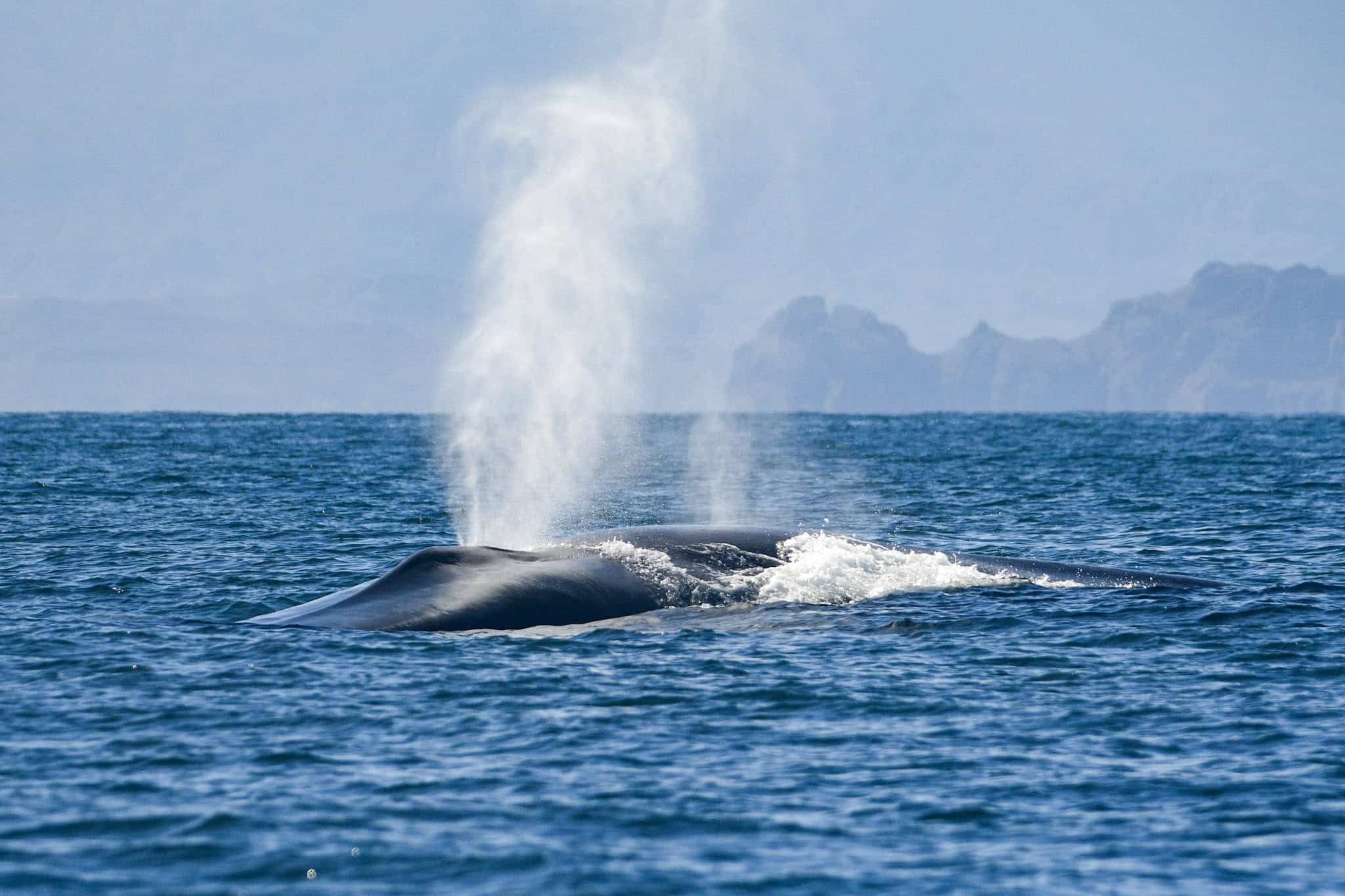
Loreto’s model of community-led, low-impact ecotourism is one that conservationists hope to see take root in whale watching regions around the world. © Michael Pierson
A Model Worth Replicating
What Maria and Rafa built in Loreto didn’t happen by accident. It required a protected area with scientists eager to translate research into practice, local operators willing to reshape behaviors and expectations, and tourism revenue that made conservation the economically rational choice, not just the ethical one.
Variations of this model are taking shape in other corners of the ocean. In the Azores, operators have shifted toward low-disturbance approaches and documented better encounters as a result. In Tonga, humpback whale tourism has grown into one of the country’s most significant sources of revenue, with ongoing efforts to strengthen regulations and educate local villages whose livelihoods are now tied to whale health.
The common thread is not geography or species. It is the alignment of economic incentive with ecological outcome, anchored in local knowledge and sustained by responsible travel. When a community has something real to gain from a living ocean, the ocean tends to stay alive. The question, for every ecosystem where this could work, is whether we get there before the chase begins.
Plan Your Baja Whale Watching Trip
From blue whales in Loreto to gray whales in San Ignacio Lagoon, our complete guide covers the best (and responsible) whale watching experiences in Baja California.