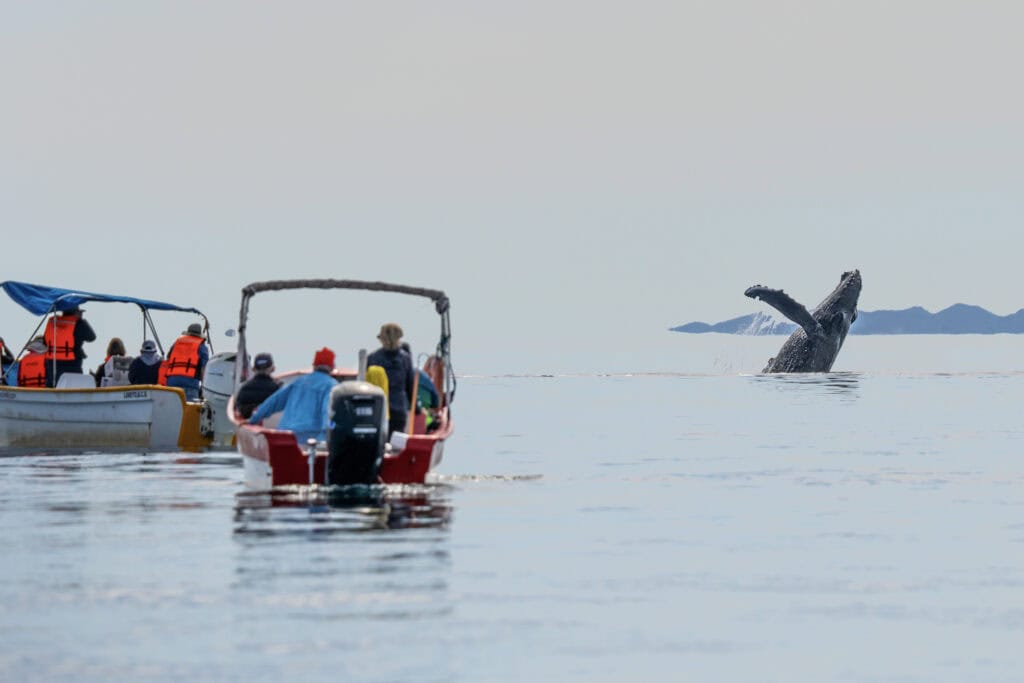
For over a decade, the community of Loreto, Baja California Sur, has championed a model of small-scale, sustainable ecotourism centered on the whales that gather each year in Loreto Bay National Park to feed and rear their young. This spring, that commitment was put to the test when a presidential decree threatened to expand cruise ship access to the UNESCO World Heritage site. What followed became a powerful example of grassroots environmental advocacy, as residents, scientists, tour operators, and conservation organizations united to protect the bay.
The Push for a Deep-Water Port
Cruise ship traffic in the Sea of Cortez had already been on an upward trend for years, something local advocates and conservation groups have pushed back against for decades, even as ships continued to anchor in Loreto Bay through legal gray areas.
On April 10, 2026, President Claudia Sheinbaum signed a decree reclassifying Loreto as a deep-water seaport, opening the bay to far more and far larger vessels.
The decree posed a serious threat to the volume of ship activity. By April 2026, Loreto had already received more than 7,600 cruise ship passengers, compared to just 1,510 across all of 2025.
Large cruise ships generate intense underwater noise that disrupts whale communication, increases stress, and interferes with essential behaviors like feeding, resting, and migration. The disturbance often forces whales to abandon important habitat or dive deeper to escape the noise.
They also increase the risk of ship strikes, one of the leading human-caused threats to whales and whale sharks worldwide.
For the roughly 20,000 residents of Loreto, the gateway to Loreto Bay National Park, the decree threatened not just the local economy, but a way of life.
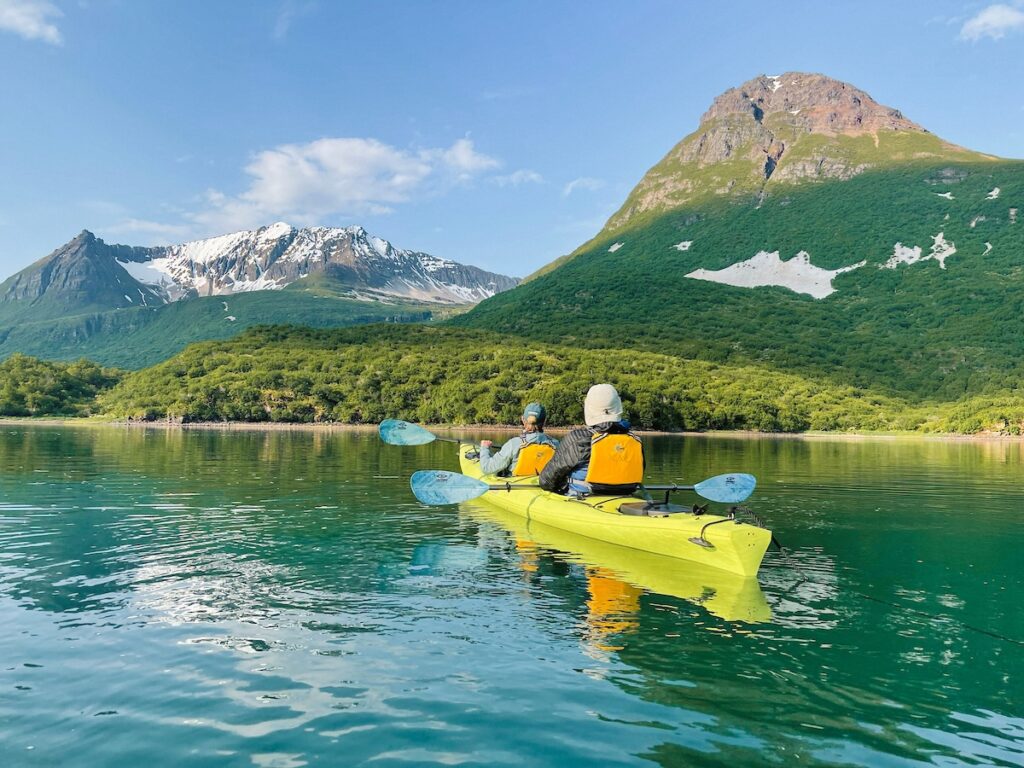
Maria Nájera, co-founder of Whales of Loreto and a long-standing partner of Oceanic Society, has been at the forefront of that way of life since she helped pioneer a low-impact whale-watching technique known as the “passive method.”
Over the years, ecotourism has transformed Loreto’s economy, and the passive whale watching method has unified the community under a shared cause of wildlife protection.
Maria and her husband, who together founded Whales of Loreto in 2012, have spent over a decade advocating for sustainable tourism practices in the bay. Over that time, the community has grown fiercely protective of its local whale population. So when plans for the deep-sea port were revealed, the community organized to push back collectively.
View this post on Instagram
The Community Responds
“We were together as a union,” she describes how the tour operators were joined by conservation groups, local businesses, universities, and families across the community expressing outrage at the plans and demanding a reversal in policy.
“It was very nice to see everybody working for the same objective.”
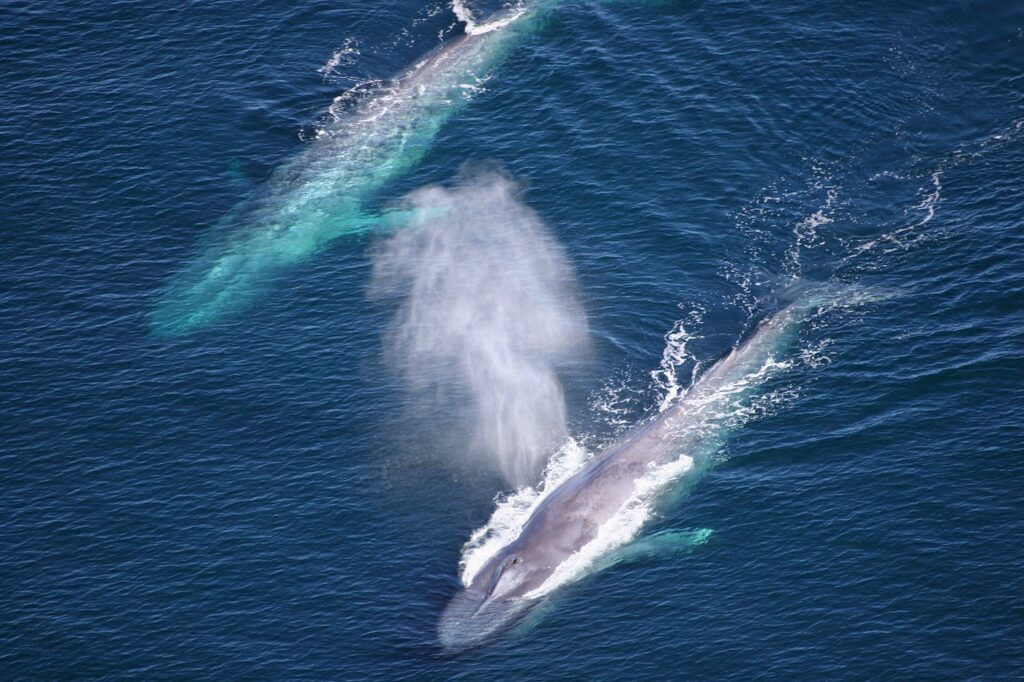
The coalition organized protests, gathered public support, and engaged directly with policymakers, arguing that the deep-water port designation violated the environmental protections attached to the park’s UNESCO status, as well as domestic laws protecting endangered species like the blue whale.
Their petition drew broad support, including from the governor of Baja California Sur, and ultimately gathered over 1.3 million signatures.
When news broke in late May that the President had revoked the decree and instead emphasized the importance of protecting Loreto Bay National Marine Park’s ecological integrity, she was shocked.
“We couldn’t believe what was going on.”
“It was a lot of pressure for the community,” Maria recalls. When the reversal was issued at the end of May, it brought a collective sigh of relief across Loreto.
What’s Still at Stake?
The repeal, published in Mexico News Daily, returns Loreto’s port status to what it was before April 10. A working group has since been established to update the park’s management plan, including new rules governing maritime traffic in the bay, with government and community representatives at the table together.
Though the decree was reversed, it doesn’t guarantee the kind of lasting, enforceable protections the community has been asking for. Cruise ships can still legally transit and anchor in the bay, just as they have for years. The real test now is whether the management plan process delivers rules with teeth and the monitoring and enforcement to back them up.
Maria is clear-eyed about what that means. “We still have much more work to do,” she says. For example, the Mexican government plans to develop an LNG pipeline through the Sea of Cortez, the construction of which would have detrimental impacts on the environment through increased noise pollution, risk of leaks, and pollution.
Maria points to cities like Santa Barbara as an example where strict regulations on maritime traffic have limited impacts on migrating whales, and hopes Baja California can institute similar measures.
© Roger Harris
Loreto’s actions are already resonating far beyond the town itself. “I think other coastal communities are learning from Loreto’s experience,” she says. “They realized we were working together as a community with one clear objective: to protect our way of life and our natural resources.” When a community organizes around a single, clear cause, she says, it leaves policymakers with little room to ignore it: “They didn’t have any other option.”
This victory shows that conservation outcomes are often driven by the people who know these places best and have the most at stake in protecting them. Local cooperatives, guides, operators, researchers, and community members have led the effort to safeguard Loreto’s waters. Whales of Loreto and those who advocated for stronger protections in Loreto National Park are a key reason these whales continue to have a safe place to return, and why our travelers have the opportunity to witness them in the wild.
We’re deeply grateful to Maria and the Loreto community for their dedication to protecting these waters. Their work is a reminder that who you travel with is never a small choice.