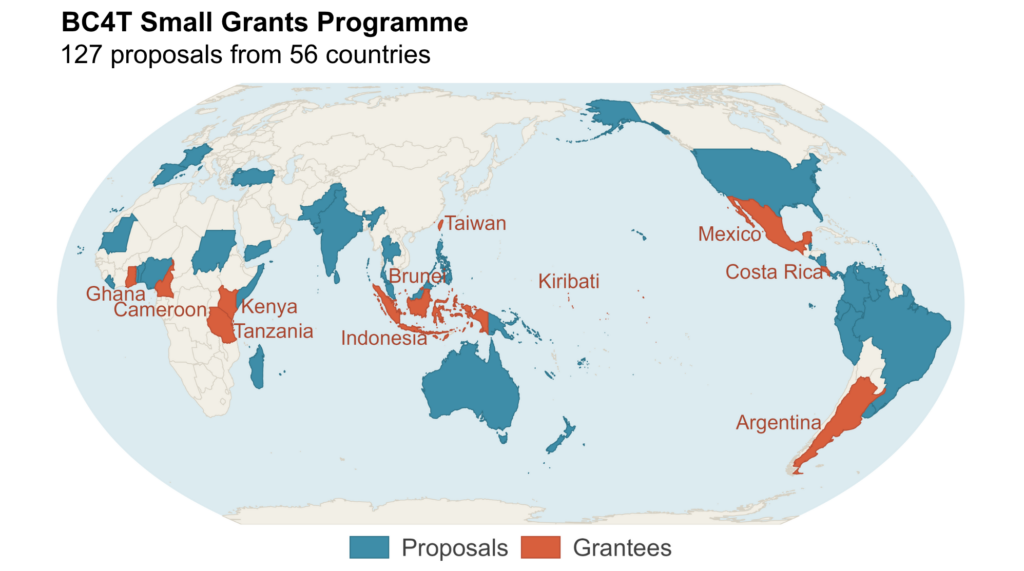
We’re proud to announce the first recipients of the Blue Corridors for Turtles (BC4T) Small Grants Program. Eleven grantees across Africa, Southeast Asia, the Pacific, and the Americas are receiving funding and equipment through the program, which Oceanic Society’s State of the World’s Sea Turtles (SWOT) program is coordinating in partnership with WWF and satellite tag maker Wildlife Computers.
Their work will help fill major gaps in what we know about where sea turtles go in the ocean, identifying the ocean habitats and migration routes that specific turtle populations depend on. Because sea turtles cross entire oceans and range widely throughout the ocean, knowing which specific areas are most important to them is essential to focus conservation efforts in the places where they can have the biggest impact.
What is Blue Corridors for Turtles?
Blue Corridors for Turtles is a global effort to track where sea turtles go and how their populations are connected — combining satellite tracking with genetic data through ShellBank, a global genetic database for sea turtles, to map their journeys across the world’s oceans. Unlike whales, dolphins, and other ocean giants, sea turtles still don’t have globally recognized important areas — areas designated because science has shown animals depend on them. BC4T, led by WWF in partnership with Oceanic Society’s SWOT program, the University of Queensland, and other conservation groups, is working to close that gap.
By bringing together nesting, tracking, and genetic data, BC4T is working to change that and give sea turtles and the communities who share their coastlines a stronger voice in how they’re protected.
To that end, BC4T has distributed $50,000, alongside five satellite transmitters (two for leatherback turtles, three for green, hawksbill, and other hardshell species), to support community-led research that helps close the gaps needed to create Important Marine Turtle Areas. Disbursed by Oceanic Society, funds went to projects addressing nesting locations, migratory patterns, and genetic connectivity, particularly those working across borders, strengthening regional collaboration, and actively involving local communities in the research itself.
2026 Blue Corridors for Turtles Grantees
Each grantee is tackling a different piece of the puzzle. Some are tracking where turtles nest, others where they travel, and others their genetic connections to other populations
Africa
Wildlife and Human Resources Organisation / WHRO Ghana (Ghana) — At its long-running study site in the Awutu/Ningo-Prampram District of the Greater Accra Region, WHRO, led by Andrews Agyekumhene, will work with local fishers to collect genetic samples from bycaught turtles, closing a key gap in West Africa’s genetic connectivity data for green, leatherback, and olive ridley turtles.
Biotope Network (Cameroon) — At Ebodjé, a recognized critical nesting habitat in Cameroon’s South Region, Biotope Network, led by Dr. Bruno Zock, will map nesting activity and collect genetic samples under ShellBank protocols while training local community monitors.
Olive Ridley Project Kenya (Kenya) — At Jumba Beach, Mtwapa, in Kilifi County, ORP-Kenya, led by Joana Hancock, will use genetic analysis to investigate a newly documented migratory route connecting Kenya’s green turtle population south to Mozambique.
Women in Conservation Organization / WICO (Tanzania) — In the Rufiji Estuary and adjacent nearshore communities of Mohoro, Msomeni, and Kaale in Pwani Region, WICO, led by Eva Johnson Ayaro, will combine satellite telemetry and genetic sampling to reveal green turtle connectivity in the Western Indian Ocean, with capacity-building support from ShellBank for this women-led team.
Photo credit: Women in Conservation
Southeast Asia & the Pacific
Nanyang Technological University (Brunei) — Along the historic nesting coastline stretching from Pelompong Island to Belait Beach, a team led by Associate Professor Hie Lim Kim of NTU Singapore, working with Universiti Brunei Darussalam, the Brunei Department of Fisheries, and Laut Brunei, will establish the country’s first systematic sea turtle monitoring program in more than two decades, piloting tagging and genetic sampling in a country with minimal prior turtle research.
Anambas Foundation (Indonesia) — At Teluk Dalam Island in the Anambas Marine Protected Area, the foundation, led by Novita Putri, will expand genetic sampling of green and hawksbill turtles to strengthen a regionally significant nesting dataset.
TurtleSpot Taiwan (Taiwan) — Across Liuqiu and Taiping Islands in the South China Sea, TurtleSpot, led by Chia-Ling Fong, will build genetic baselines from archived and stranded green turtles alongside nesting surveys, addressing a major connectivity gap in the region.
Ministry of Environment, Lands and Agricultural Development (Kiribati) — On Abaiang Island, the Ministry will generate the first systematic, community-led data on marine turtle nesting and genetics, with support from ShellBank and SPREP.
The Americas
AquaMarina (Argentina) — At San Clemente in Buenos Aires province, the species’ southernmost known foraging ground, AquaMarina, led by Victoria González Carman, will work with artisanal fishers to satellite-tag adult male leatherback turtles — a life stage almost entirely unstudied in the South Atlantic — linking findings to the Inter-American Convention for the Protection and Conservation of Sea Turtles (IAC).
Latin American Sea Turtles (Costa Rica) — At Golfo Dulce, near Puerto Jiménez in Puntarenas, LAST, led by Didiher Chacón Chaverrí, will extend more than fifteen years of in-water hawksbill monitoring, using satellite tracking to locate the nesting beaches used by its resident foraging females and connect that data to the wider CMAR region.
Uella Environmental Research & Consulting (Mexico) — Across the nesting sites of Costa Careyes and Punta de Mita in Jalisco and Nayarit, Dr. Catherine Hart will advance hawksbill satellite-tracking data management to compare movement patterns between the two isolated northern Pacific nesting populations.
What Happens Next
The data these eleven grantees collect will feed directly into BC4T’s wider connectivity data, which will ultimately support the creation of Important Marine Turtle Areas through regional workshops planned to begin under the IUCN-SSC Marine Turtle Specialist Group’s guidance by the end of 2026.
In this way, eleven small, locally-led projects become part of a much larger, global effort to chart the connectivity that will determine where and how marine turtles are protected in the years ahead.