Oceanic Society traveler Amber King has taken her use of iNaturalist far beyond that of a casual user. The app helps people identify plants and animals they encounter in the field and document their sightings, which can then be shared with a global community of naturalists, researchers, and other wildlife enthusiasts.
As a passionate iNaturalist contributor and ambassador, Amber has documented thousands of wildlife observations and nearly 6,000 species around the world. For her, photographing wildlife isn’t simply about getting a beautiful picture. It is a way of creating a permanent record and contributing data that can help scientists better understand the natural world.
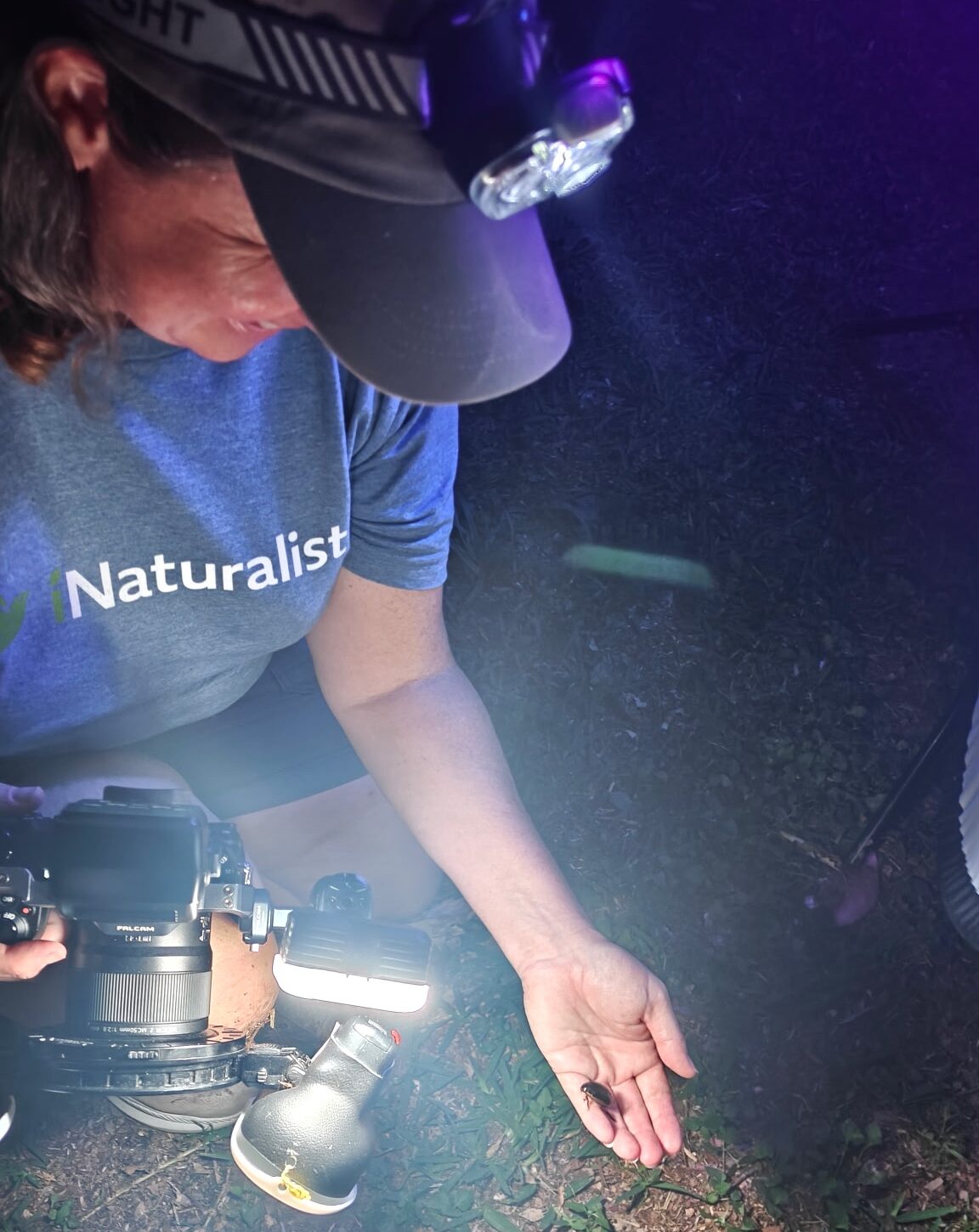
During the 2026 City Nature Challenge, Amber King examines a beetle drawn in by the moth sheet’s UV light. Photo by Allison Gianelloni.
So when Amber joined her family on an Oceanic Society expedition to Costa Rica, she brought that same curiosity and careful attention with her. Over the course of the trip, she would add hundreds of species to her growing list. But one of her smallest discoveries would turn out to be one of the most remarkable.
The First Photos of a Living Enoclerus cinereus
The encounter took place at the Bosque del Cabo Lodge on the Osa Peninsula when Amber and her sister set up a moth sheet and a small ultraviolet light beneath the deck of their bungalow, attracting an assortment of nocturnal insects.
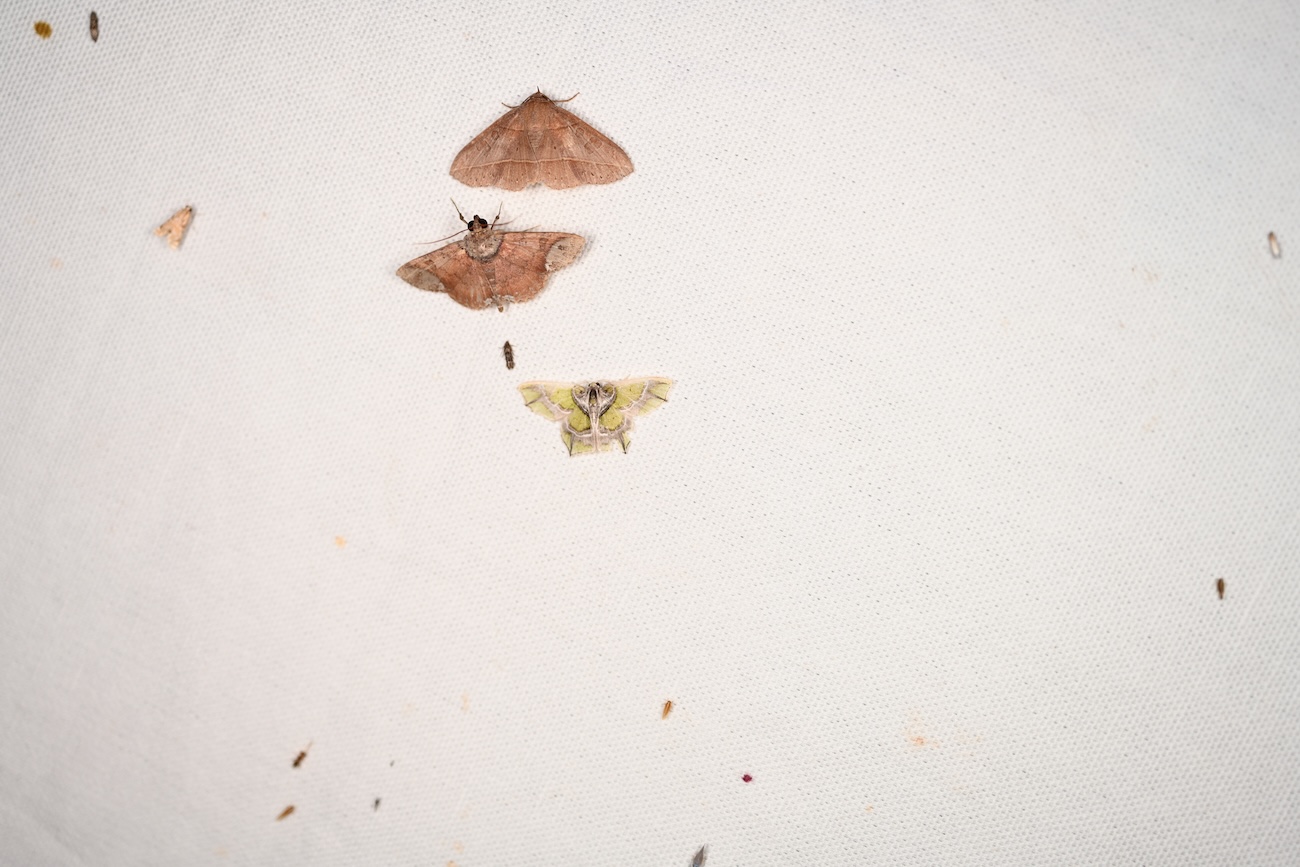
Moths settle on the sheet alongside a scatter of beetles and tiny insects. Photo by Amber King.
Amber, who describes herself as a “moth fanatic,” was eager to participate in National Moth Week, a global event that invites wildlife enthusiasts to explore the hobby of “mothing”, share photos that contribute to citizen science, and celebrate the role moths play in ecosystems.
The light soon attracted an assortment of moths and other nocturnal insects. But among them was a peculiar little beetle. Its unusual shape and silvery coloration caught their attention, so they photographed it and uploaded the observation to iNaturalist.
At first, even Amber couldn’t identify exactly what they had found. “Even after I did some research, I could only guess it was in the checkered beetle family.”
The photograph didn’t immediately produce an answer. Instead, it entered the iNaturalist community, where other naturalists and experts could examine it, discuss it, and eventually identify it.
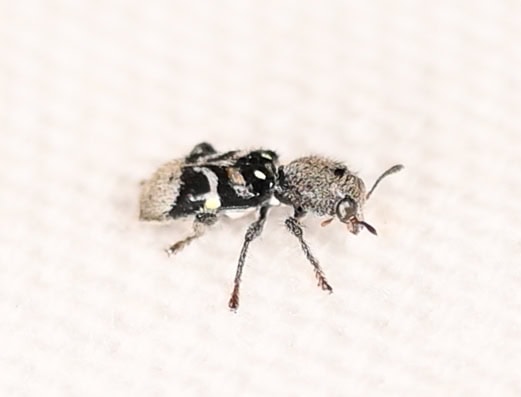
Enoclerus cinereus, photographed alive for the first known time, its silvery, banded body catching the light on a moth sheet in the Osa Peninsula. Photo by Amber King.
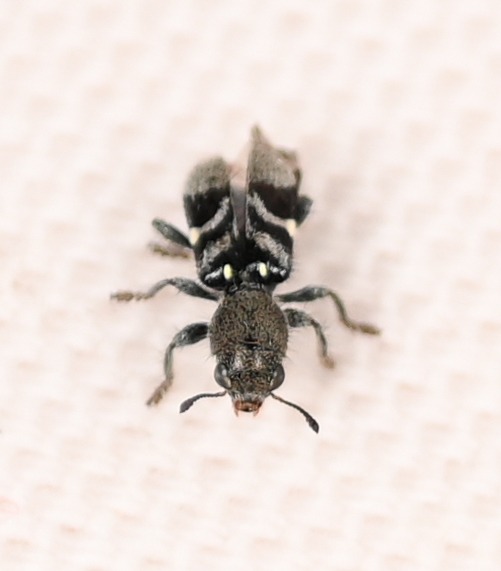
Close-up of Enoclerus cinereus checkered beetle, first known live photograph, silver and black banded pattern. Photo by Amber King
A Two-Week Journey to an Identification
For nearly two weeks, the observation sat on iNaturalist without a definitive species identification.
Then it caught the attention of an entomologist, who tagged another iNaturalist user who is a specialist in the Checkered Beetle family, or Cleridae.
The specialist went beyond comparing photographs. They turned to the scientific literature and historical collections to investigate what Amber had photographed.
The answer was Enoclerus cinereus, a rare species of checkered beetle in the family Cleridae (subfamily Clerinae). Like other members of its genus, it belongs to a group of predatory beetles found around woody plants and tree bark.
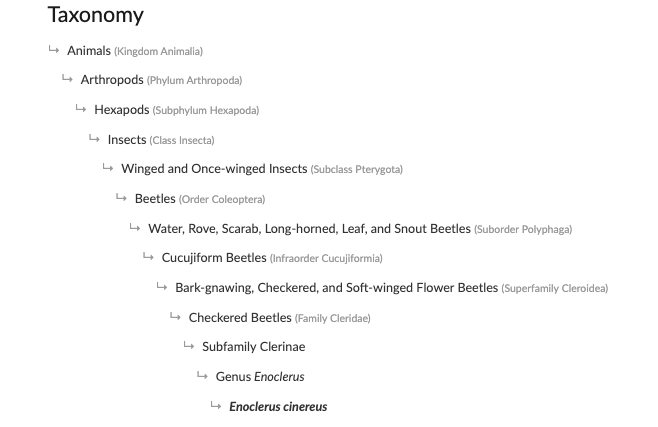
The full taxonomic path for Enoclerus cinereus, a checkered beetle in the family Cleridae, tracing its place from kingdom down to species.
Amber’s research into the species revealed an unusually sparse documented history. Only a handful of old, pinned specimens appeared to exist in the Smithsonian’s insect collection.
The investigation also uncovered an intriguing explanation for the beetle’s unusual appearance. A study of the silver beetle’s mimicry concluded that its distinctive black-and-silver coloration and bulky body shape resemble certain turtle ants, flat, armored rainforest ants that nest in dead branches high in the forest canopy. Some turtle ant species have dark bodies with patches of short, pale hairs that create a silvery, variegated appearance remarkably similar to the beetle’s pattern.
Because the silver beetle is also arboreal (tree-dwelling), researchers suggest that this resemblance may help protect it from predators. One possibility is that the beetle is mimicking the ants’ distinctive appearance as a way of signaling that it would make an unappealing meal, since turtle ants can produce chemicals that taste and smell bad to insectivores.
In other words, the beetle’s unusual appearance may be more than a striking visual characteristic. It could be an evolutionary defense, allowing this tiny rainforest beetle to resemble an insect that predators have good reason to avoid.
Next came the most remarkable part of the discovery.
The First Known Photographs of a Living Enoclerus cinereus
As the experts worked through the identification and available scientific records, it became clear that Amber’s photographs appeared to document something that had never been photographed before: a living Enoclerus cinereus.
The significance wasn’t that the species itself was newly discovered. E. cinereus had already been scientifically described.
Rather, the photographs and documentation of where they were taken provided something that had apparently been missing from the record: images of the species alive, in its natural environment.
The iNaturalist community subsequently created a dedicated taxon page for the species, giving the observation a permanent place within the platform’s growing record of global biodiversity.
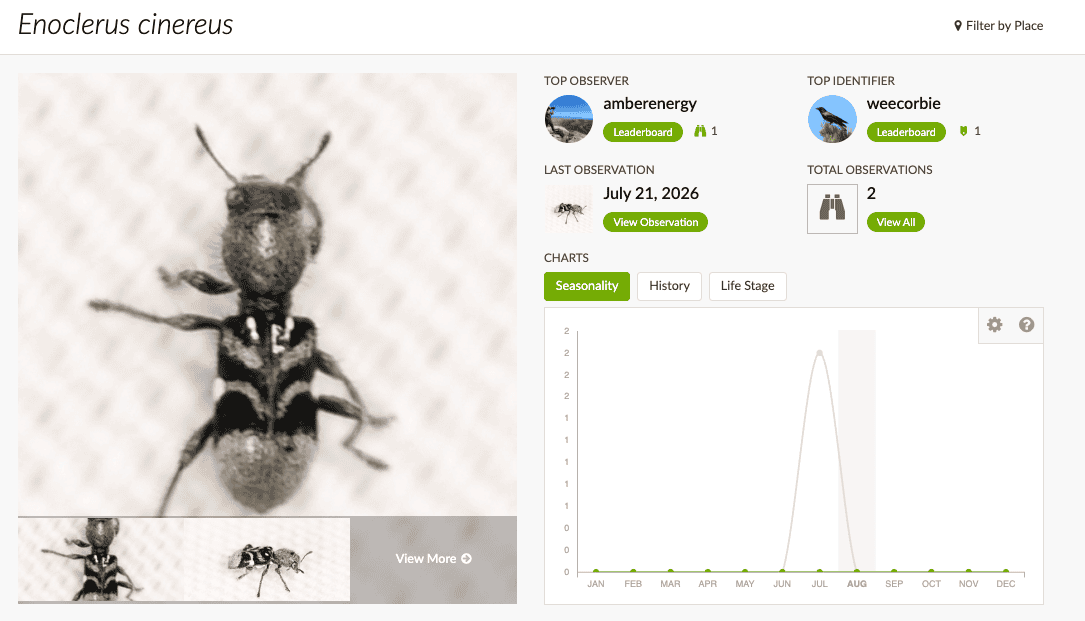
iNaturalist taxon page for Enoclerus cinereus showing reference photo and observation location on the Osa Peninsula
The discovery was an unexpected outcome of something that began as a family activity on a rainy night in Costa Rica. “It was so thrilling to learn that a fun hobby during a family trip to Costa Rica could also ‘rediscover’ a rare rainforest beetle and contribute valuable biodiversity data.”
Why a Photograph Can Matter to Science
That phrase, “rediscover,” captures what makes the encounter so compelling. The beetle wasn’t unknown to science, but it had been extraordinarily difficult to encounter and document. For decades, its presence was represented largely by specimens preserved in scientific collections. Amber’s photograph helped bring the species back into view as a living part of the rainforest.
For biodiversity researchers, observations like this can become valuable scientific records. Through iNaturalist, photographs are shared with a global community of naturalists, taxonomists, and researchers who can help identify species, expand our understanding of where they occur, and add new pieces to the world’s growing record of biodiversity.
With over 6 million active users across 197 countries and over 300 million observations, iNaturalist’s impact comes from an incredible global community of everyday people, serious naturalists, and scientists getting outside to explore the natural world, in their own backyard or on an Oceanic Society adventure.
Curious to see what else Amber found?
See the 473 species Amber documented during her Oceanic Society private family trip to Costa Rica, from colorful birds and mammals to moths, butterflies, and rare rainforest insects.