On a windy morning in 2017, Kay and her husband, Rob, set out from San Francisco aboard a boat bound for the Farallon Islands, a secluded archipelago only visible from the shoreline on the clearest of days.
This rocky scattering of islands serves as a nesting and feeding ground for hundreds of thousands of seabirds and a diverse array of other marine life. Great white sharks patrol the deep Pacific waters in search of seals and sea lions. Tufted Puffins nest in rocky crevices along the shoreline. Northern right whale dolphins, humpback whales, blue whales, and more than 30 other cetacean species regularly feed in the productive waters.
As Pacific swells sprayed off the bow of the boat, childhood dreams of exploring the ocean began to resurface in Kay’s mind.
“I was born in New Mexico,” she says, “but I wanted to be Jacques Cousteau,” the pioneering French oceanographer and explorer who introduced the world to places like Belize’s Great Blue Hole and the coral reefs of Fiji throughout his explorations into the 1990s.
Some of her earliest memories involve desert lizards skittering across sandstone, yet it was the blue whales—the largest animals ever to inhabit the planet—that captivated her while watching The Undersea World of Jacques Cousteau on Sunday nights. Her parents, though largely uninterested in the ocean themselves, supported her fascination by purchasing the Time Life Cousteau Library, a collection of books and videos that fueled her imagination.
“I taught myself everything from those books, absolutely certain I was going to be a marine biologist,” Kay says, reflecting on those childhood days with her nose in a book, dreaming about adventures on faraway seas and the many other wondrous creatures of the ocean.
She laughs that, in school, she quickly realized she had little disposition for science and math. Her career path led first to the music industry and later to law, while her passion for the ocean remained dormant for decades. She had no idea that the journey to the Farallon Islands would reawaken the adventurous little girl who still lived within her.
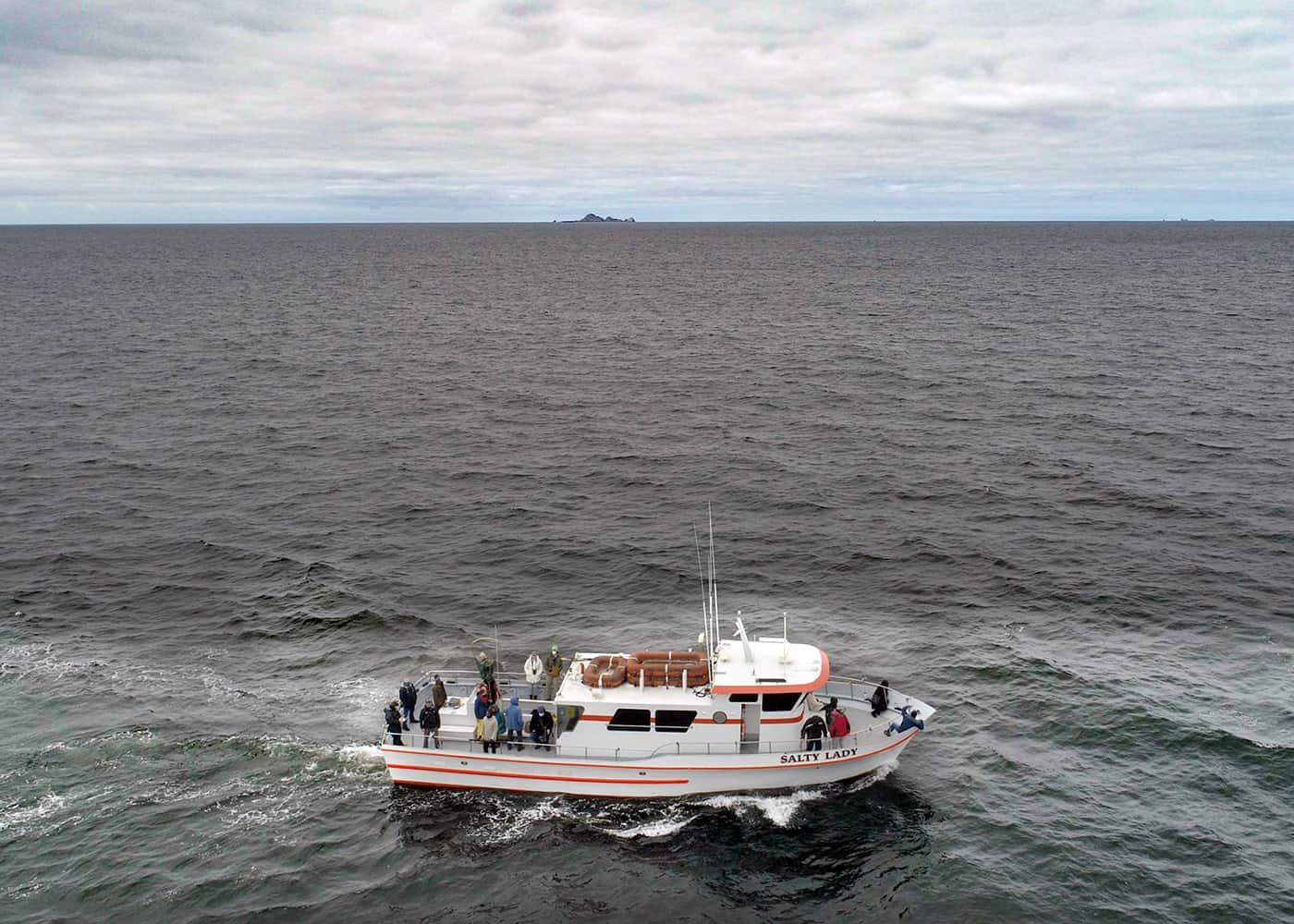
Oceanic Society whale watchers aboard the Salty Lady, with the Farallon Islands visible on the horizon.
While patrolling the Islands in search of wildlife, their Oceanic Society naturalist was alerted to a gathering of cetaceans a half hour further west into the Pacific, beyond the continental shelf. There, the sea floor drops into the abyss, and nutrient-rich waters from the deep bring massive quantities of krill to the surface. This krill attracts whales, like humpback, blue, and fin whales, but also many of the over 300,000 seabirds that live on these islands. The adventurous group, enticed by the prospect, decided to brave the choppy waters in search of a wild encounter.
As they approached, they were met by pods of orcas, humpback whales, and gray whales. “Everything was out there,” reflects Kay, as she watched, wonderstruck at the various cetaceans breaching and feeding all around them. Humpbacks were feeding on krill so close to their vessel that they could smell their shrimpy breath.
“I’m just, you know, giggling inside about how cool this is,” she says. She knew there was a slim chance they could spot a blue whale at the Farallon Islands, but thought they wouldn’t be so lucky. Then, amidst the feeding frenzy, their guide spotted a blue whale in the distance—its vapor plume rising as high as 30 feet.
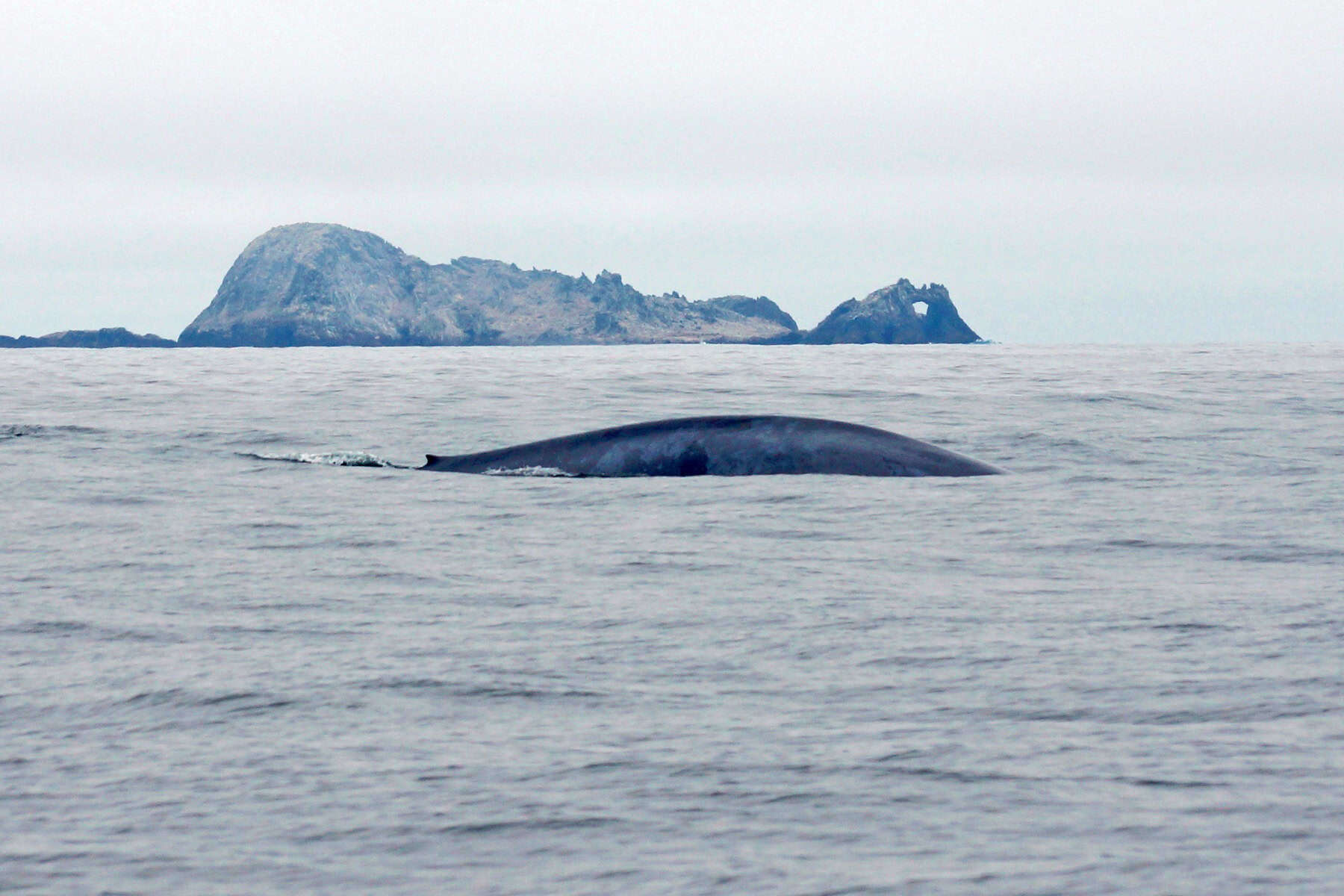
A blue whale in front of the Farallon Islands, a globally important hotspot for marine life located just off of San Francisco. © Chris Biertuempfel
She felt the excitement rooted in her young, ocean-enthralled self rising within her, leaving her with a lingering thought: “Why has this not been a thing for me all these years?”
That single moment launched a decade of globe-trotting adventures with her husband, taking them to remote corners of the world and immersing them in responsible wildlife encounters.
A Decade of Oceanic Adventures
Since that first transformative trip, Kay and Rob have traveled extensively with Oceanic Society, exploring some of the most extraordinary marine and wildlife destinations on the planet.
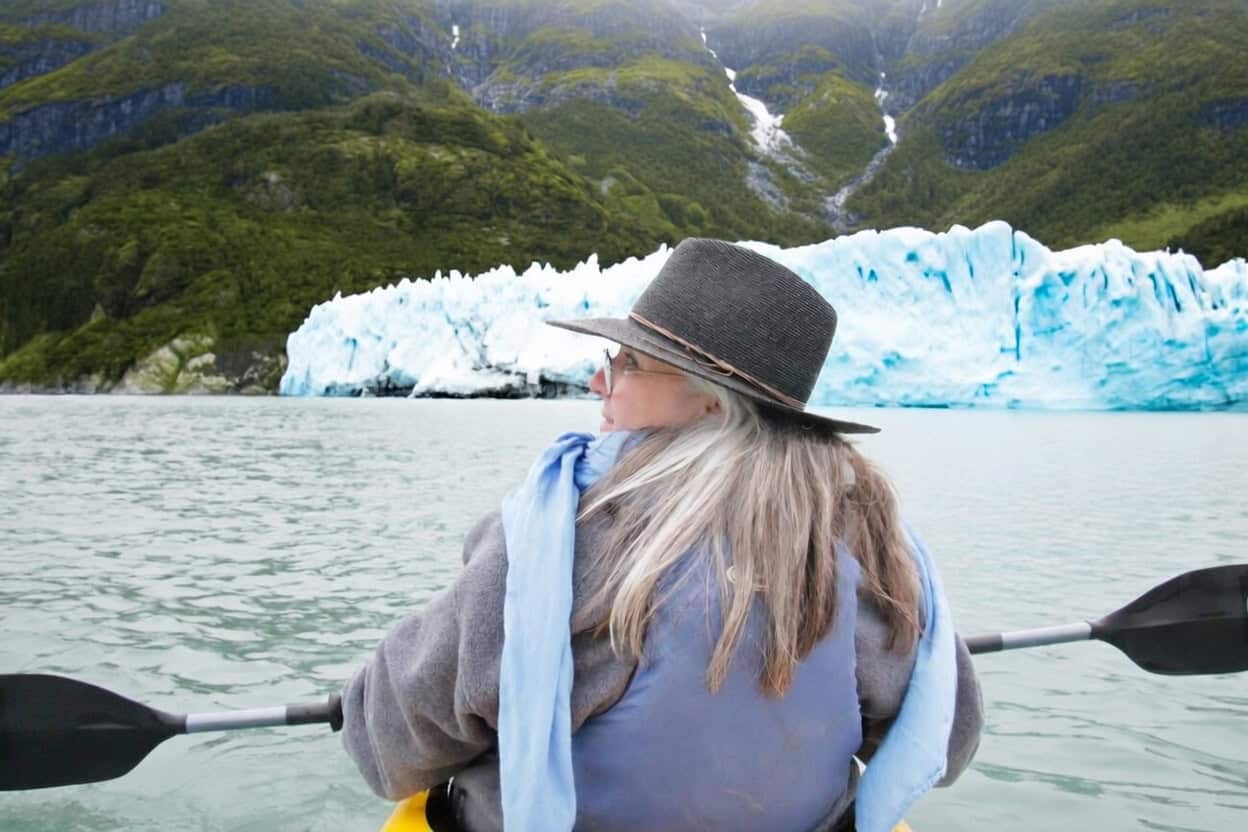
Their journeys have taken them to the iceberg-studded bays of Southeast Alaska, sweeping savannas and coastlines of Kenya, the gray whale lagoons of Baja California, the humpback calving waters of Tonga, and soon, to the Galápagos Islands. Each expedition has offered unforgettable wildlife encounters and deepened their connection to the oceans and the ecosystems they support.
Kay is a proud member of Oceanic Society’s Explorers Circle, a community of frequent travelers who have repeatedly ventured to the far reaches of the world with us.
For her, each journey has been more than a trip; it is a continuation of the childhood dream she once held for Jacques Cousteau, now realized through guided, responsible exploration alongside experts and fellow nature enthusiasts.
Expanding Your Comfort Zone
Not only did that trip to the Farallon Islands in 2017 inspire a decade of ocean adventuring, but it also showed Kay and her husband just how immersive wildlife encounters can be.
Today, they joke that the unmistakable smell of humpback whale breath was the moment they knew they were fully immersed in the wild—and was the moment that planted the travel bug.
“Whale breath will get you every time,” she jokes.
More seriously, she describes how ecotourism has the power to ground you in the present, immersing you in the natural world in a way that quiets the noise of modern life and brings a deep sense of calm. Experiences like these invite travelers to see the world from a new perspective, often in ways they may not have imagined before.
During their expedition, she remembers feeling unsure as the boat moved farther out to sea. But with the support of the crew and the excitement building around her, she stayed with the experience and was rewarded with a moment that would shape her path for years to come.
“Oceanic Society does a really good job of creating situations that really do require you to step outside of your own box,” she says, providing a safe and supportive environment that invites travelers to lean into truly raw adventures while benefiting from the guidance of their expert team.
After that formative trip, she and her husband, entranced by whales, sought trips that could bring them even closer to these incredible ocean giants—taking them to renowned whale watching destinations like Baja California and Tonga.
Baja California is a thin peninsula of mountainous desert in western Mexico, sandwiched between the Pacific and the Sea of Cortez—the latter of which was dubbed the “world’s aquarium” by Jacques Cousteau due to its incredible biodiversity. But Baja is perhaps most famous for its unique community of gray whales that seemingly seek out human touch in quiet lagoons, a behavior seen nowhere else in the world.
While camping on the shores of the lagoon, winds whipped across the desert throughout the night. Though sleep was scarce, the next day’s adventures in the lagoon in search of gray whales more than made up for it, providing a rush of energy and excitement that carried them through the day.
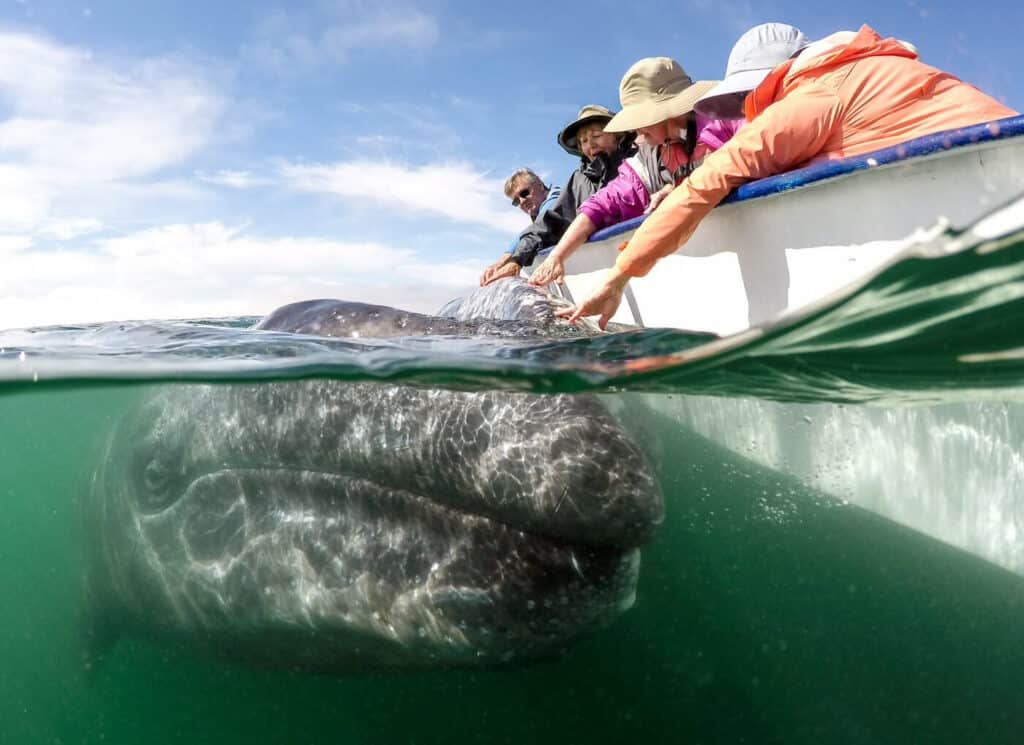
Kay clearly remembers the moment when a gray whale mother approached their zodiac with her calf. “The next thing you know, the mom is sort of pushing the calf up to the boat, like: ‘Look, here’s my baby, isn’t he cute?’” The mother watched as they gently stroked the back of the baby whale—an experience that sparked a profound sense of amazement and respect.
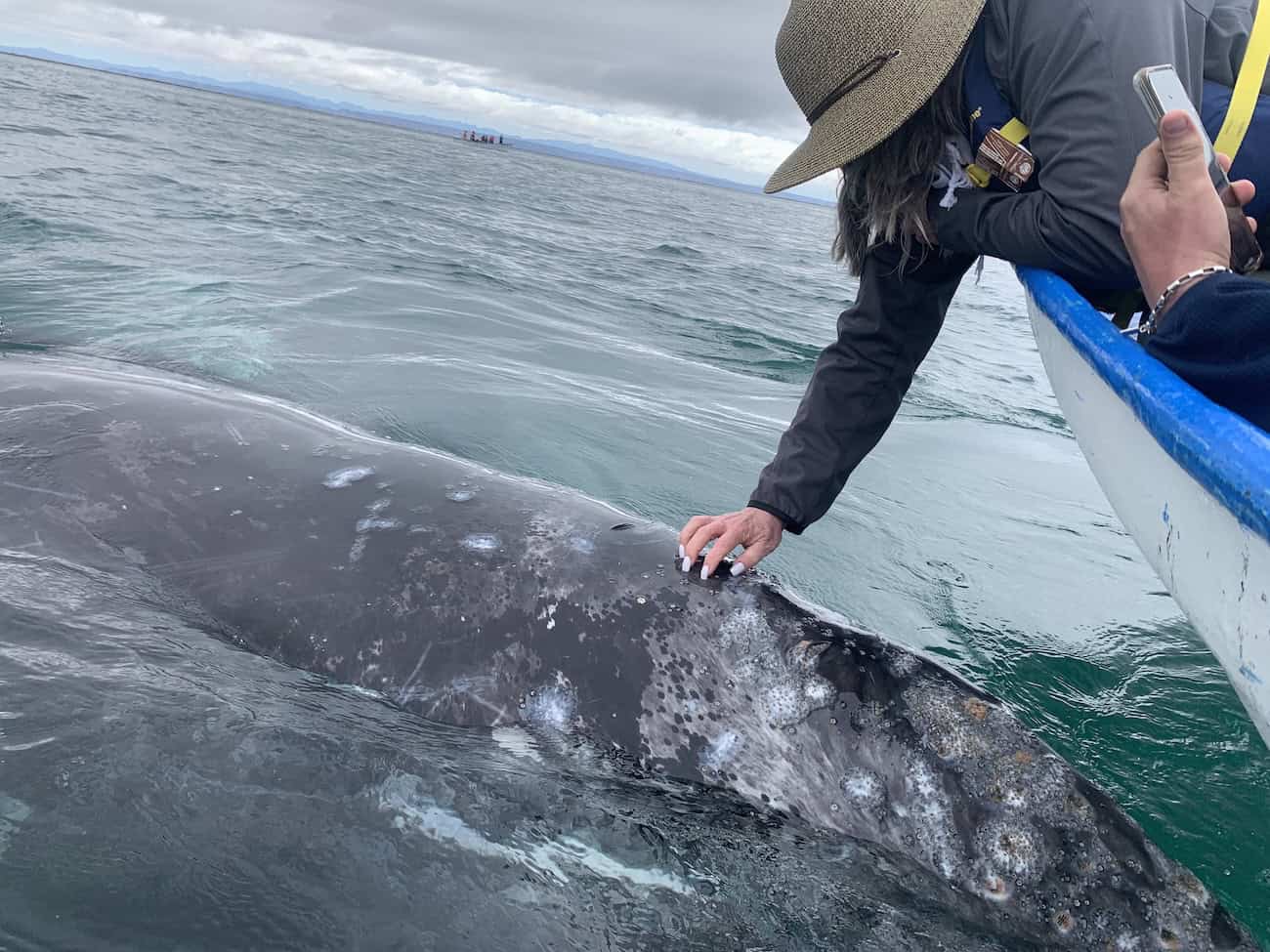
Kay interacts with a gray whale calf in Baja California during an Oceanic Society expedition. She described the moment as a “gift” that opened her eyes to an incredibly unique interaction between animals and humans.
Kay described the moment as a “gift” that opened her eyes to an incredibly unique interaction between animals and humans, and one that exhibits the power of ecotourism in reshaping economies. Those same lagoons once served as whaling grounds; today, they sustain communities through responsible whale watching.
These personal breakthroughs become even more powerful in a group setting, where travelers support one another through shared challenges.
While snorkeling with sperm whales in Dominica, Kay witnessed a young traveler from Belgium confront her severe fear of deep, dark water. Sperm whales dive thousands of feet to hunt giant squid, and Dominica is one of the few places where you can swim with them in the open ocean. Despite her fear, the traveler entered the water and was greeted by the whales’ distinctive clicking language and watched them surface. Upon returning to the boat, she grasped Kay’s hands in delight. The entire group celebrated her courage.
As Kay describes it, once one person “feels the gratitude chip,” everyone’s experience is amplified.
Embracing Uncertainty in the Wild
Another key to fully immersing oneself in nature, as Kay has learned over the last decade, is that wildlife is unpredictable.
“You can’t just snap your fingers and expect a whale to appear beneath you”, she explains. Ethical ecotourism is about witnessing wildlife on their own terms, observing, appreciating, and respecting animals in their natural habitat, without altering their behavior.
That means there are no guarantees. For travelers who can release their expectations, these experiences often become much more rewarding, offering a true glimpse into the rhythms of the natural world. If a tour operator guarantees an encounter or sighting, it is often a red flag that they may use unethical methods to make it happen. It is important to check that their practices truly prioritize the well-being of the animals.
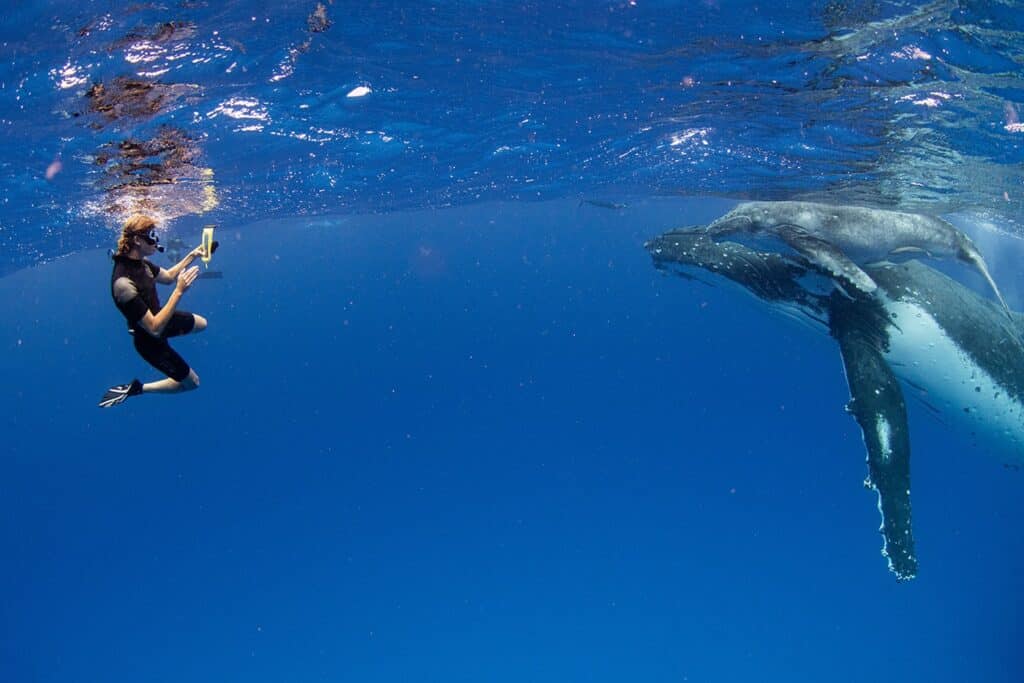
Kay recalls her own visit to Tonga in 2022 with Oceanic Society, where she and her husband hoped to swim with humpback whales, one of the few places in the world where encounters are legal and strictly regulated. They approached the trip with grounded expectations, understanding that sightings could not be guaranteed and that patience and respect were central to the experience.
When they finally came across a humpback mother and her calf and swam out into the open ocean swells so they could snorkel alongside these massive creatures, which grow to the size of a bus, she did not know what to expect.
As they peered into the deep and watched as the pair swam up for air with powerful strokes, the calf took interest in Kay and naturalist Rosie Jeffrey. The calf veered towards them within a few feet, and for a moment locked eyes with them, leaving them stunned as it twirled around to rejoin its mother.
When they surfaced, Kay and Rosie looked at each other, wonderstruck.“What just happened?” Kay asked, still trying to process the moment.
Rosie, who has spent extensive time guiding expeditions in Tonga and understands these whales and their rhythms, smiled and told her not to expect that again—that was a “unicorn” moment, the kind that rarely happens.
Though there are no guarantees in ecotourism, truly extraordinary encounters are possible.
For Kay, she felt a surge of appreciation for just how lucky they were.
“I always dreamed of what it was like in those places and to do those things,” reflects Kay. “This is what Jacques Cousteau was talking about.”